
Tesla’s Latest Patent Reveals New Robotic Hand Design for Optimus
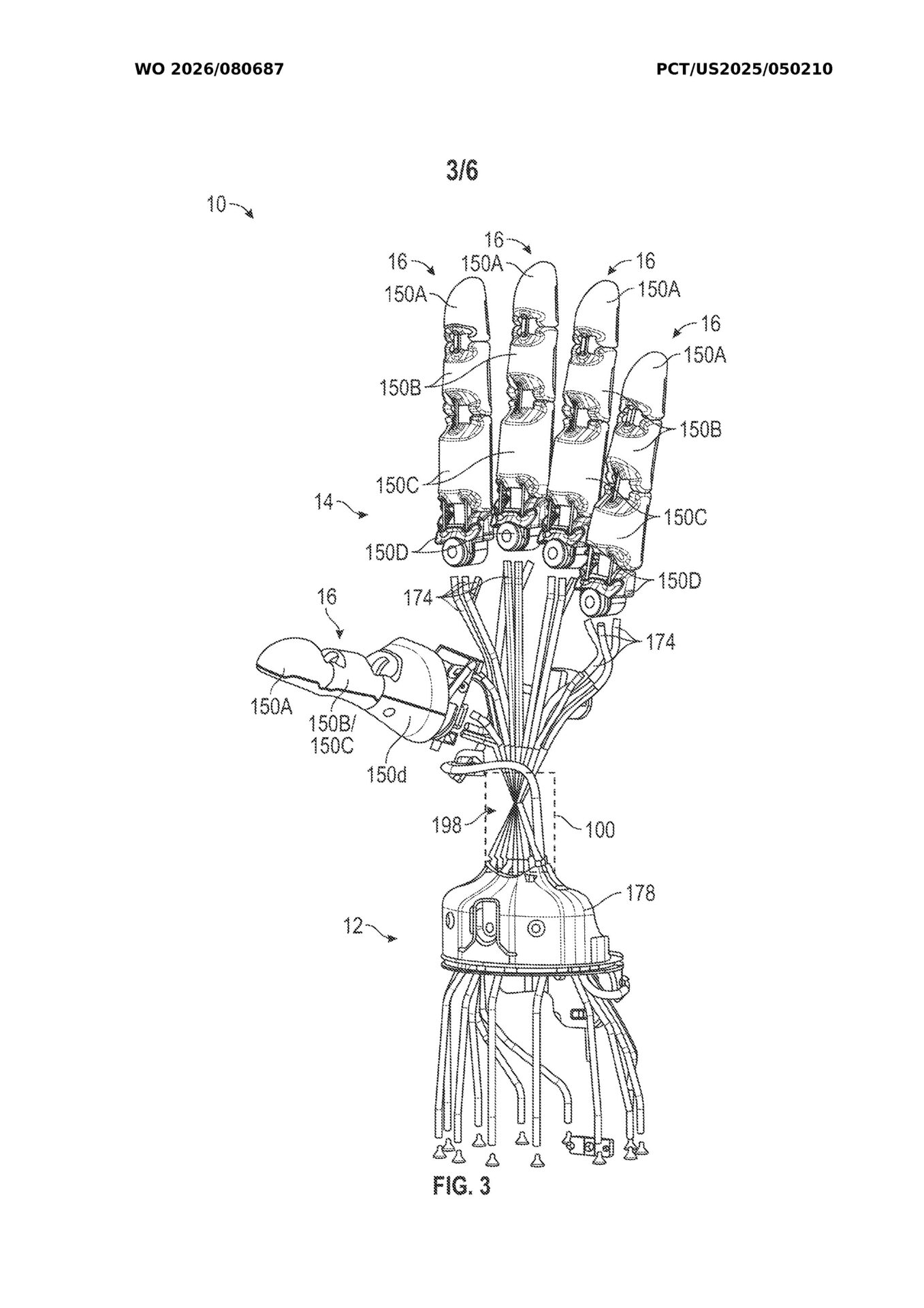
Tesla has recently filed a patent for a groundbreaking robotic hand design, offering a glimpse into the intricate engineering behind its humanoid robot, Optimus. The international patent, titled “Mechanically Actuated Robotic Hand,” showcases a five-fingered hand controlled by a network of cables that run from the forearm through the wrist and into each finger, akin to the functioning of tendons in a human hand. This innovative design boasts 22 degrees of freedom, doubling the capabilities of its predecessor.
The Fingers:
Each finger consists of four segments connected by rolling joints, mirroring the mechanics of human knuckles for a more natural bending motion. The thumb, with three segments, and the other fingers, with four segments each, are controlled by three cables. These cables are strategically routed through grooves in the finger segments to ensure precise movement, preventing any unintended actions. Additionally, springs inside each finger enable automatic return to an open position when the cables are released.
The Wrist:
The wrist of the robotic hand can move in two directions—tilting up and down and rotating side to side—using only two motors, a feat achieved through a clever arrangement of joints. To prevent unintended finger movement, the control cables are rotated as they pass through the wrist joint, transitioning from a horizontal layout on the forearm side to a vertical stack on the hand side. This meticulous design minimizes crosstalk and ensures seamless coordination between wrist and finger movements.
The Bigger Picture:
The level of detail in the patent filing indicates that Tesla has been refining this design for over a year, showcasing a robust and advanced engineering approach. By leveraging established robotics research and optimizing for manufacturing scalability, Tesla aims to create a dexterous robotic hand that is both efficient and practical for real-world applications. This innovative design represents a significant step forward in humanoid robotics, bridging the gap between simplicity and complexity.
Elon Musk’s recent announcement about Optimus 3 being almost ready underscores Tesla’s commitment to pushing the boundaries of robotics technology. Despite a slight delay in the unveiling of Optimus 3, the progress made in developing this advanced robotic hand signifies a significant milestone in Tesla’s journey towards creating cutting-edge humanoid robots. Stay tuned for more updates on Optimus 3 and the groundbreaking innovations shaping the future of robotics. The world is full of wonders, and one of the most awe-inspiring natural phenomena is the Northern Lights. Also known as the Aurora Borealis, these stunning light displays can be seen in the night sky in polar regions around the world.
The Northern Lights are caused by the interaction between charged particles from the sun and the Earth’s magnetic field. When these particles collide with molecules in the Earth’s atmosphere, they emit light of varying colors, creating the beautiful displays we see in the sky.
The colors of the Northern Lights can range from green and pink to red and purple, depending on the type of gas particles being excited by the solar particles. The most common color is green, which is caused by oxygen molecules in the atmosphere.
The best places to see the Northern Lights are in countries located near the North or South Pole, such as Norway, Sweden, Finland, Iceland, Canada, and Alaska. These regions have a high probability of clear skies and low light pollution, making them ideal for viewing the Aurora Borealis.
Many people travel to these regions specifically to see the Northern Lights, as it is a truly unforgettable experience. Some even believe that the lights have mystical powers and bring good luck to those who witness them.
In addition to being a beautiful natural phenomenon, the Northern Lights also have scientific significance. Studying the Aurora Borealis can help scientists better understand the Earth’s magnetosphere and the effects of solar activity on our planet.
Overall, the Northern Lights are a breathtaking spectacle that never fails to captivate those lucky enough to witness them. Whether you’re a scientist studying their scientific properties or a traveler seeking a once-in-a-lifetime experience, the Aurora Borealis is sure to leave you in awe of the wonders of the natural world.