
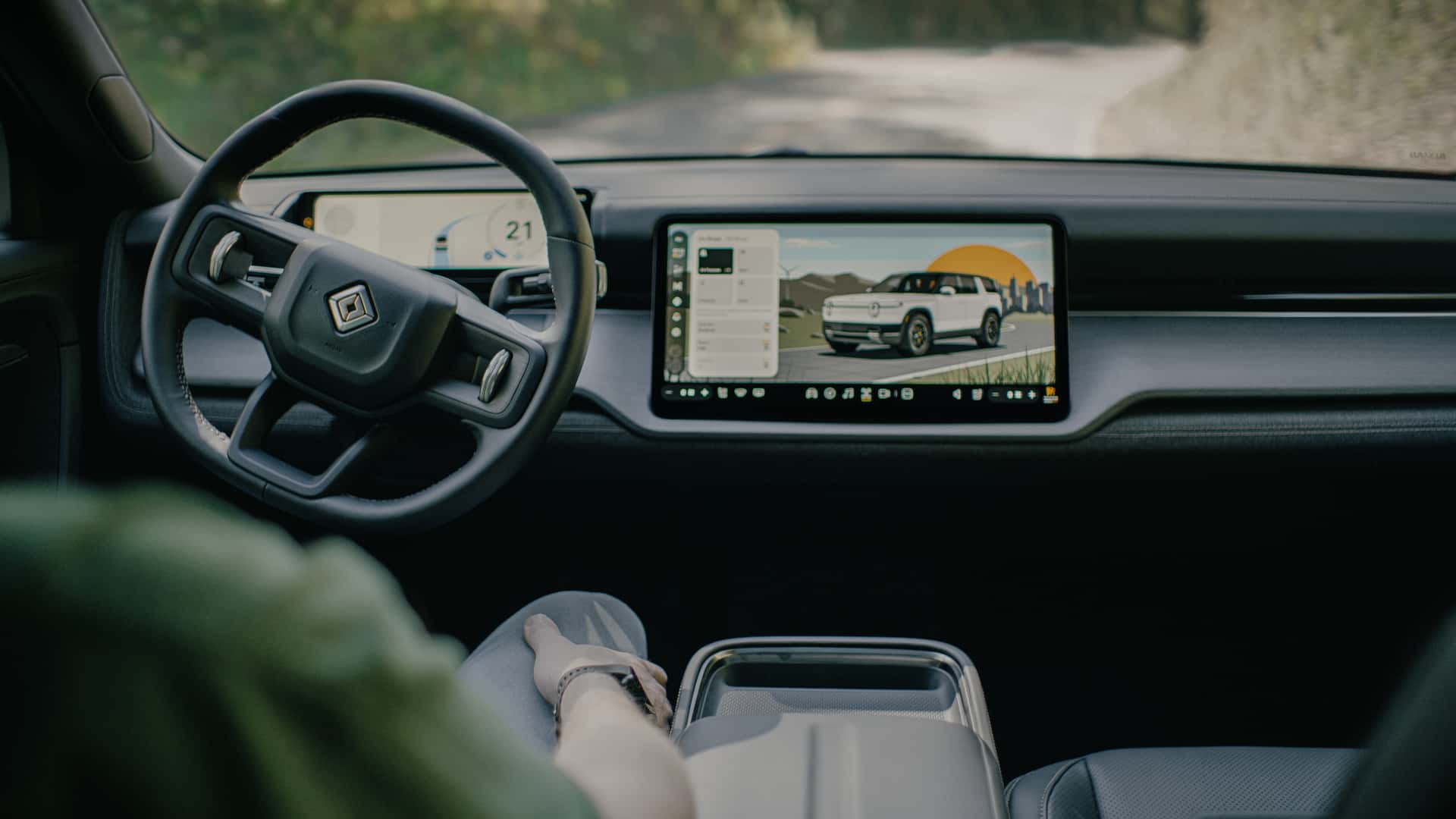
Rivian, a leading electric vehicle manufacturer, is making a bold statement by declaring that the future of in-car controls lies in artificial intelligence (AI) in the cabin. This assertion essentially puts an end to the ongoing debate over Apple CarPlay integration, at least from Rivian’s perspective. While some consumers may still prefer the convenience of Apple CarPlay and Android Auto, Rivian believes that AI-driven interfaces will revolutionize the way drivers interact with their vehicles.
In a recent interview on the Decoder podcast, Rivian’s chief software officer, Wassym Bensaid, discussed the company’s software philosophy. Bensaid emphasized that Rivian is not in favor of incorporating CarPlay into its vehicles, as they believe that voice control is the ultimate interface for interacting with the car’s software. According to Bensaid, relying on screen-mirroring technology like CarPlay poses challenges in terms of taking over the entire infotainment system, which goes against Rivian’s vision of user interaction.
Looking ahead, Rivian is placing its bet on AI as the preferred method for drivers to control major vehicle functions. Features like Rivian Assistant are set to become central to the driving experience as AI technology continues to evolve. However, Bensaid acknowledges that the success of AI integration hinges on improving voice recognition technology. Rivian customers have previously voiced concerns about the effectiveness of in-car voice recognition, highlighting the importance of continual software development and refinement.
Bensaid argues that AI renders the CarPlay debate irrelevant, stating that AI-defined cars are the future. By prioritizing voice control as the primary interface, Rivian aims to streamline user interactions and reduce the reliance on physical buttons and menus. This approach not only simplifies the user experience but also allows for faster feature updates and enhancements without waiting on third-party partners.
Despite initial consumer demand for CarPlay integration, Rivian’s steadfast commitment to AI-driven interfaces has led to a significant decline in requests for CarPlay. Bensaid attributes this shift to the continuous improvement and innovation in Rivian’s in-house software solutions, which have outpaced the development of similar features in CarPlay. Additionally, Rivian plans to implement safeguards to prevent excessive AI usage, such as rate-limiting users to control compute costs.
In conclusion, Rivian’s embrace of AI in the cabin signals a new era in automotive technology, where voice-controlled interfaces are poised to revolutionize the driving experience. While the debate over CarPlay integration may continue among consumers, Rivian’s focus on AI-driven solutions underscores the company’s commitment to pushing the boundaries of in-car controls and software innovation.
However, for the car to truly be able to process conversational commands using its own hardware and software, it will require a significant amount of computing power and advanced AI algorithms. This means that automakers will have to invest heavily in research and development to make this a reality.
One of the key advantages of having a car that can process conversational commands on its own is the reduced dependency on data centers. This means that even in areas with poor connectivity or when the data center is down, the car will still be able to understand and respond to voice commands effectively.
Rivian’s approach to building its own AI-powered system shows a commitment to innovation and pushing the boundaries of what is possible in the automotive industry. By taking control of the technology that powers its vehicles, Rivian is ensuring that it can provide a seamless and user-friendly experience for its customers.
As more automakers start to explore AI-powered systems for their vehicles, we can expect to see a shift towards more intelligent and intuitive cars in the future. The ability to have a conversation with your car and have it understand and respond to your commands opens up a world of possibilities for how we interact with our vehicles.
While there are still challenges to overcome, such as ensuring the privacy and security of user data, the future of AI-powered cars looks promising. With companies like Rivian leading the way, we can expect to see more intelligent and autonomous vehicles on the roads in the coming years.
Overall, the idea of a car that can process conversational commands using its own hardware and software is an exciting prospect that could revolutionize the way we interact with our vehicles. It’s a step towards a future where cars are not just modes of transportation, but intelligent companions that can anticipate our needs and provide a truly personalized driving experience.