
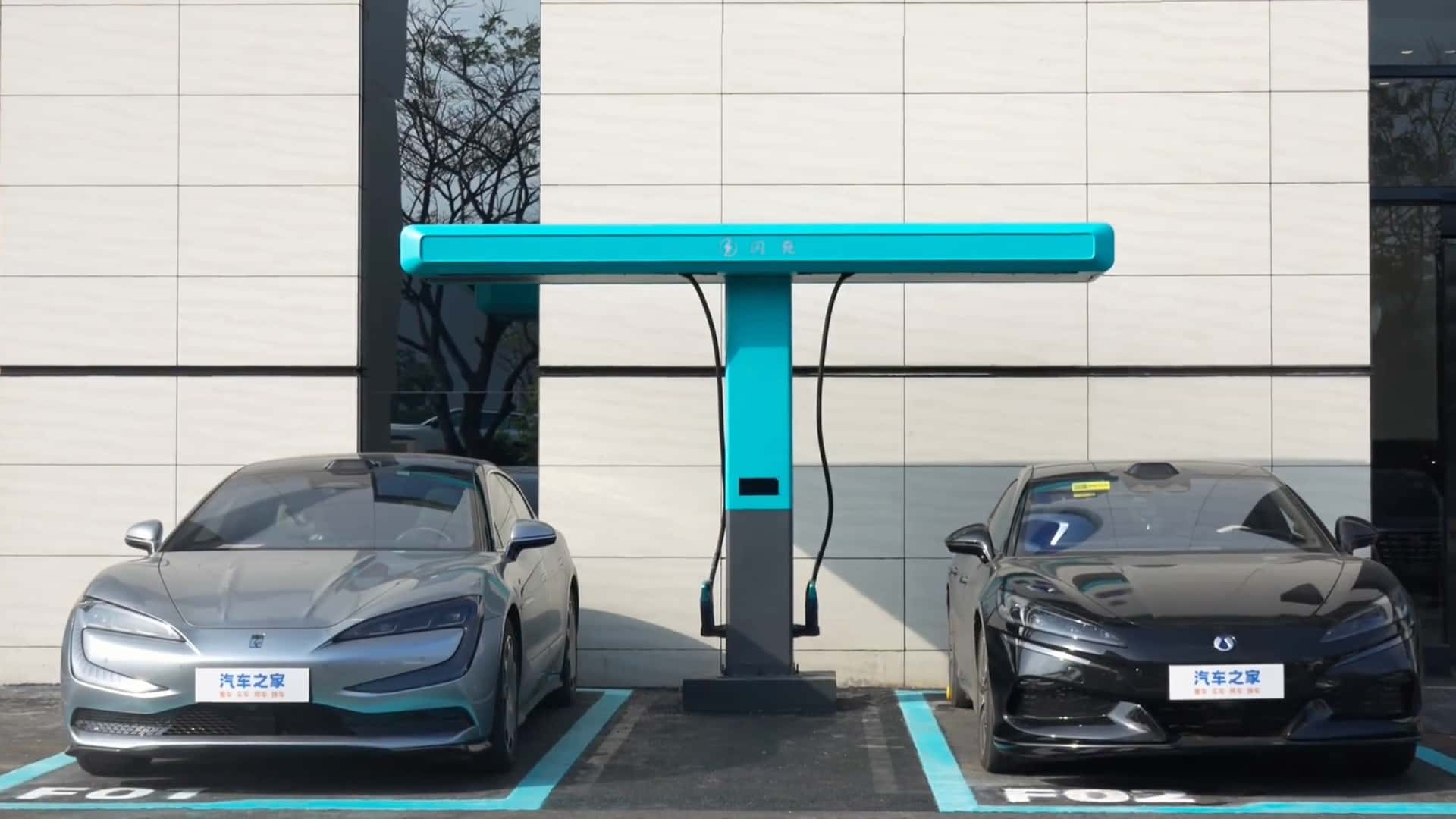
BYD, the Chinese electric vehicle giant, has once again raised the bar in the world of EV charging with its latest innovation – the Flash chargers. These new chargers are capable of delivering a staggering 1,500 kilowatts of power, making them the fastest chargers in the market. Electric vehicles equipped with BYD’s new Blade 2.0 battery can recharge to nearly full in under 10 minutes using this new technology.
The design of the T-shaped charging towers is reminiscent of traditional gas stations, making it easy for EV drivers to pull up and quickly recharge their vehicles. This user-friendly design aims to make the charging experience as seamless and convenient as possible.
Just a year ago, BYD introduced its megawatt chargers, which were already setting new standards for fast charging. The company’s latest Flash chargers take this to the next level, delivering even faster charging speeds. These chargers can provide 1,500 kilowatts of peak charging power, thanks to 1,500 amps of current and a 1,000-volt base architecture. This is three times faster than Tesla’s latest V4 Superchargers in the U.S.
In addition to the new Flash chargers, BYD also unveiled its second-generation Blade lithium-iron phosphate battery. When paired with the Flash charger, vehicles equipped with the Blade 2.0 battery can charge from 10-70% in just five minutes and reach 97% in about 9 minutes. Even in extreme temperatures as low as -30 degrees Celsius, the battery can charge from 20-97% in just 12 minutes.
BYD demonstrated the impressive charging performance of its new technology by taking a Denza Z9 GT for a drive and draining its battery down to 9% state of charge. After plugging it into the 1,500 kW Flash charger, the car’s range jumped from 58 miles to 626 miles in just 9 minutes and 51 seconds. This showcases the incredible speed and efficiency of BYD’s new charging infrastructure.
While the range estimates may be slightly inflated due to the Chinese testing cycle, the overall impact of BYD’s new Flash chargers is undeniable. With nearly 400 miles of driving range added in under 10 minutes, EV drivers can now enjoy faster and more convenient charging stops, bringing us one step closer to a future of electric mobility. BYD, the Chinese automaker known for its electric vehicles, is making waves in the EV industry with its revolutionary Flash charging technology. The company’s latest innovation, the Denza Z9 GT, can add nearly 1,000 km of range in just over 9 minutes. That may not be exactly as quick as filling up a car with gas, but it’s damn close.
In a recent independent charging test conducted by InsideEVs contributor Tom Moloughney, the Lucid Gravity, one of the fastest charging EVs in the U.S., was left in the dust by the Denza Z9 GT. The Lucid Gravity took 12.5 minutes to go from 0-50% state of charge on a 350 kW EVgo station, adding only about 200 miles of range in that time.
The design and arrangement of these new Flash charging stations reflect the lightning-fast charging speeds. Resembling a traditional gas station, these T-shaped towers feature “zero-gravity” guns that are lightweight and easy to maneuver. They also offer plug-and-charge functionality, eliminating the need for drivers to deal with apps and payment systems.
BYD is aggressively deploying Flash chargers, with approximately 4,200 stations already built in China. The company aims to have 20,000 stations operational by the end of this year, ensuring that more than 90% of urban areas in China will have access to a Flash charger within 5 kilometers.
Not content with dominating the Chinese market, BYD is also expanding its Flash charging network to Europe, Latin America, the Middle East, Africa, and the Asia Pacific region. This ambitious expansion plan will make ultra-fast charging accessible to EV drivers around the world.
The massive power output of these Flash chargers could strain the existing electricity grid, so BYD plans to install energy storage batteries at these sites for better load distribution and power management. Grid batteries, which are also increasingly common at charging stations in North America, store energy during off-peak hours and release it during peak periods, while also storing surplus energy from renewable sources like solar.
BYD is leading the charge in the megawatt charging revolution, but other Chinese automakers are quickly following suit. An arms race is emerging in China as automakers race to roll out ultra-fast charging stations to meet the growing demand for EVs. With Flash charging technology, the future of electric vehicle charging is looking brighter and faster than ever before. However, with the rapid advancements being made in China, it seems that the tables may soon turn. Chinese companies like Zeekr and Huawei are pushing the boundaries of electric vehicle technology, developing megawatt chargers that far surpass anything currently available in the U.S.
Zeekr, a subsidiary of Geely Auto Group, has recently unveiled their own megawatt chargers, joining the ranks of other Chinese companies in the race to develop the fastest and most efficient charging technology. These chargers are capable of delivering up to 1 megawatt of power, allowing for incredibly fast charging times that could revolutionize the EV industry.
Not to be outdone, technology giant Huawei has also entered the fray, developing their own megawatt chargers that promise to be even more advanced and efficient. With their expertise in telecommunications and technology, Huawei is poised to make a big impact on the electric vehicle market with their cutting-edge charging technology.
In contrast, the fastest public chargers currently available in the U.S. top out at around 500 kilowatts, and even those are not yet widely deployed. The slow progress in the U.S. can be attributed to a variety of factors, including regulatory hurdles, infrastructure challenges, and a lack of investment in charging technology.
The heavy tariffs imposed on Chinese EVs and technology were initially intended to protect the domestic auto industry and give it room to grow. However, with the rapid advancements being made in China, it is becoming increasingly clear that the U.S. may soon find itself playing catch-up in the electric vehicle market.
As Chinese companies like Zeekr and Huawei continue to push the boundaries of electric vehicle technology, it will be interesting to see how the U.S. responds. Will American companies be able to keep pace with the rapid advancements being made overseas, or will they be left behind in the race to develop the next generation of electric vehicles and charging infrastructure? Only time will tell.