
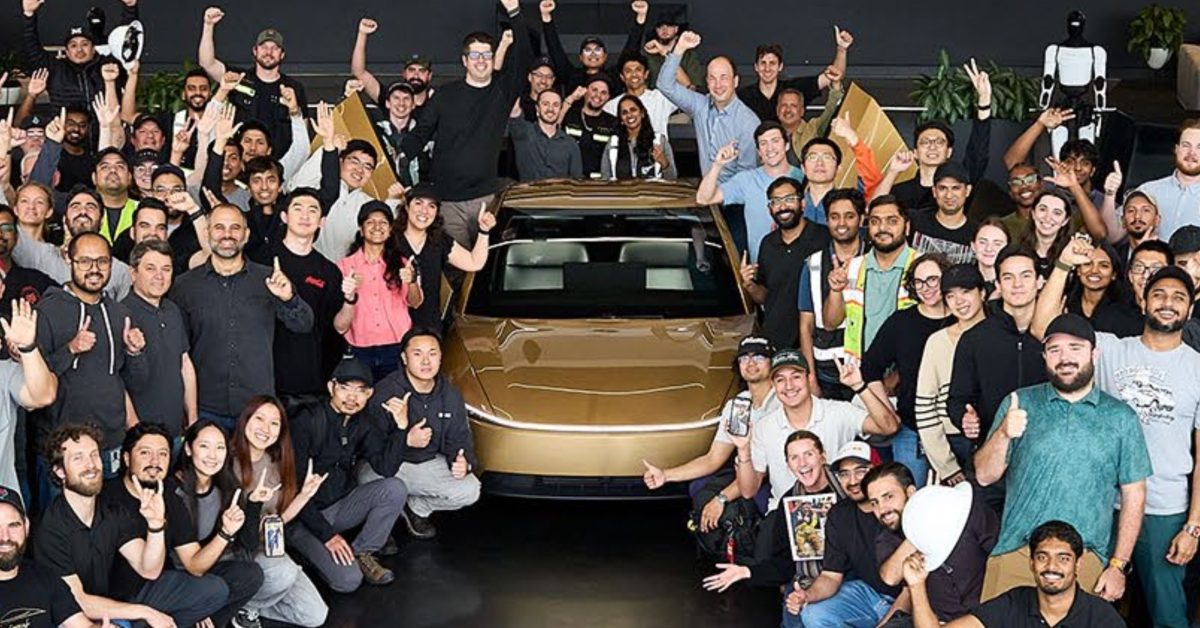
Tesla Cybercab Production Begins at Giga Texas
CEO Elon Musk recently announced during Tesla’s Q1 2026 earnings call that Cybercab production has officially commenced at Giga Texas. This marks a significant milestone for Tesla as they venture into the autonomous vehicle market.
VP of Vehicle Engineering Lars Moravy also confirmed that the Cybercab will not be subject to NHTSA’s 2,500-vehicle annual production cap for autonomous vehicles. This exemption is typically required for vehicles that do not meet all Federal Motor Vehicle Safety Standards (FMVSS).
Tesla’s approach to bypassing the production cap is unique. Unlike companies like Waymo and Cruise that rely on exemptions, Tesla designed the Cybercab to comply with all existing FMVSS standards independently. This means that the vehicle meets safety, bumper, and theft prevention standards without the need for special regulatory treatment.
With the Cybercab already sporting official federal compliance stickers, Tesla can scale production without being constrained by exemption limits. This is a significant advantage as Congress debates raising the autonomous vehicle exemption cap from 2,500 to 90,000 units through the SELF DRIVE Act.
While production has started, Musk cautioned that the initial phase will follow an S-curve trajectory. He mentioned that the production of Cybercab and Semi vehicles will start slow but ramp up exponentially towards the end of the year. This aligns with Tesla’s long-term strategy to prioritize Cybercab production due to the high demand for ridesharing services with fewer passengers.
One of the key challenges Tesla faces with the Cybercab is achieving unsupervised autonomous driving. Despite being designed to operate without a driver, Tesla has yet to solve this issue. Musk mentioned that unsupervised Full Self-Driving may be available to customers by Q4 of this year, although Tesla’s track record with FSD timelines has been inconsistent.
Additionally, the recent departure of several senior leaders from the Cybercab program raises concerns about the project’s leadership stability. The vehicle program manager, OTA and ride-hailing infrastructure director, and assembly leader have all left Tesla in recent months, leaving the project without any original program managers.
In conclusion, while Tesla has made significant progress with Cybercab production, the success of the vehicle ultimately hinges on achieving functional unsupervised autonomy. Until then, the vehicle will only be utilized in Tesla’s small-scale geofenced robotaxi pilot projects. The glossy plastic look of the Cybercab in the production unit has also raised questions about its aesthetic appeal compared to the original metallic finish concept.