
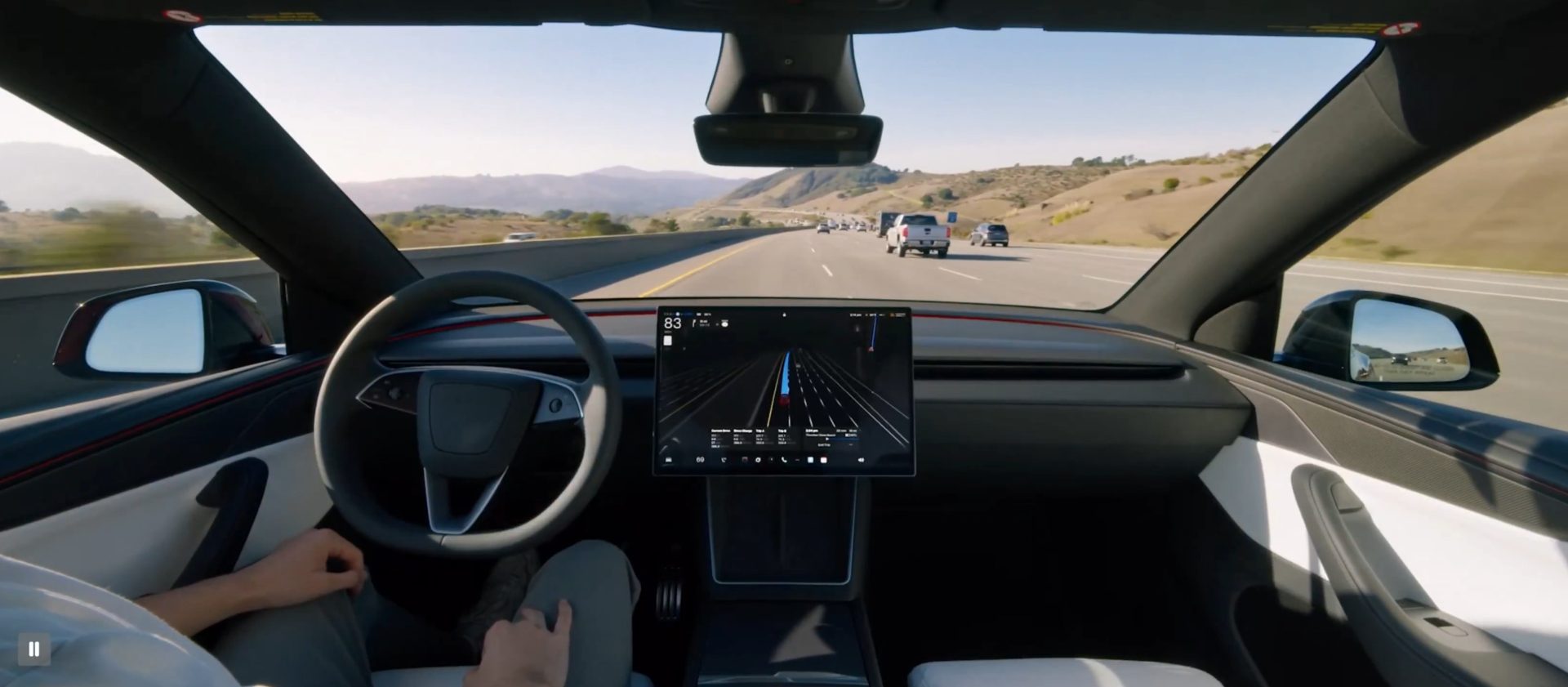
Tesla’s Full Self-Driving (FSD) software has long been touted for its convenience and potential for autonomous driving, but a recent real-world story shared by a Twitter user, JJackBrandt, sheds light on a more profound aspect of the technology: its ability to save lives.
In a heartfelt article posted on X, JJackBrandt recounted how FSD played a crucial role in saving his father’s life during a life-threatening heart attack. The incident took place on November 15, 2025, when Brandt’s father was driving his 2026 Model Y Launch Edition from Atlanta to Birmingham along I-20 West. Thanks to the recent FSD v14.1.3 update, the vehicle was equipped with the latest self-driving capabilities that would prove to be a lifesaver.
As Brandt narrates, his father suddenly experienced severe chest pain while driving in the early hours of the morning. Unable to control the vehicle and on the verge of losing consciousness, his father managed to call Brandt for help. With FSD engaged, the car continued to navigate safely on the road while Brandt quickly sprang into action.
Using the Tesla app, Brandt remotely redirected the car’s navigation to the nearest hospital, Tanner Medical Center in Carrollton, Georgia. Despite his father’s deteriorating condition, Brandt was able to guide the vehicle towards the emergency room entrance, all from the comfort of his own 2014 Model S.
In a miraculous turn of events, the Model Y autonomously rerouted, exited the highway, turned around, and pulled up directly in front of the hospital’s emergency room entrance. Medical professionals later confirmed that Brandt’s father had suffered a massive STEMI heart attack that required immediate intervention on three arteries. Had it not been for the swift actions enabled by Tesla’s FSD technology, the outcome could have been far more dire.
Brandt expressed his gratitude for the four key factors that contributed to his father’s survival, with Tesla’s FSD and the ability to remotely intervene through the Tesla app playing a pivotal role. This real-life scenario serves as a powerful testament to the life-saving potential of advanced driver-assistance systems like FSD.
This story adds to a growing list of testimonials where Tesla’s FSD technology has been credited with preventing accidents and saving lives. As Tesla continues to push the boundaries of autonomous driving, with plans to transition FSD to a subscription-only model, the conversation around the true value of this technology as a safety lifeline is bound to intensify.
In conclusion, while FSD may still require driver supervision in consumer versions, the impact it can have in emergency situations like the one experienced by Brandt’s father showcases the transformative power of advanced self-driving technologies in real-world scenarios.