
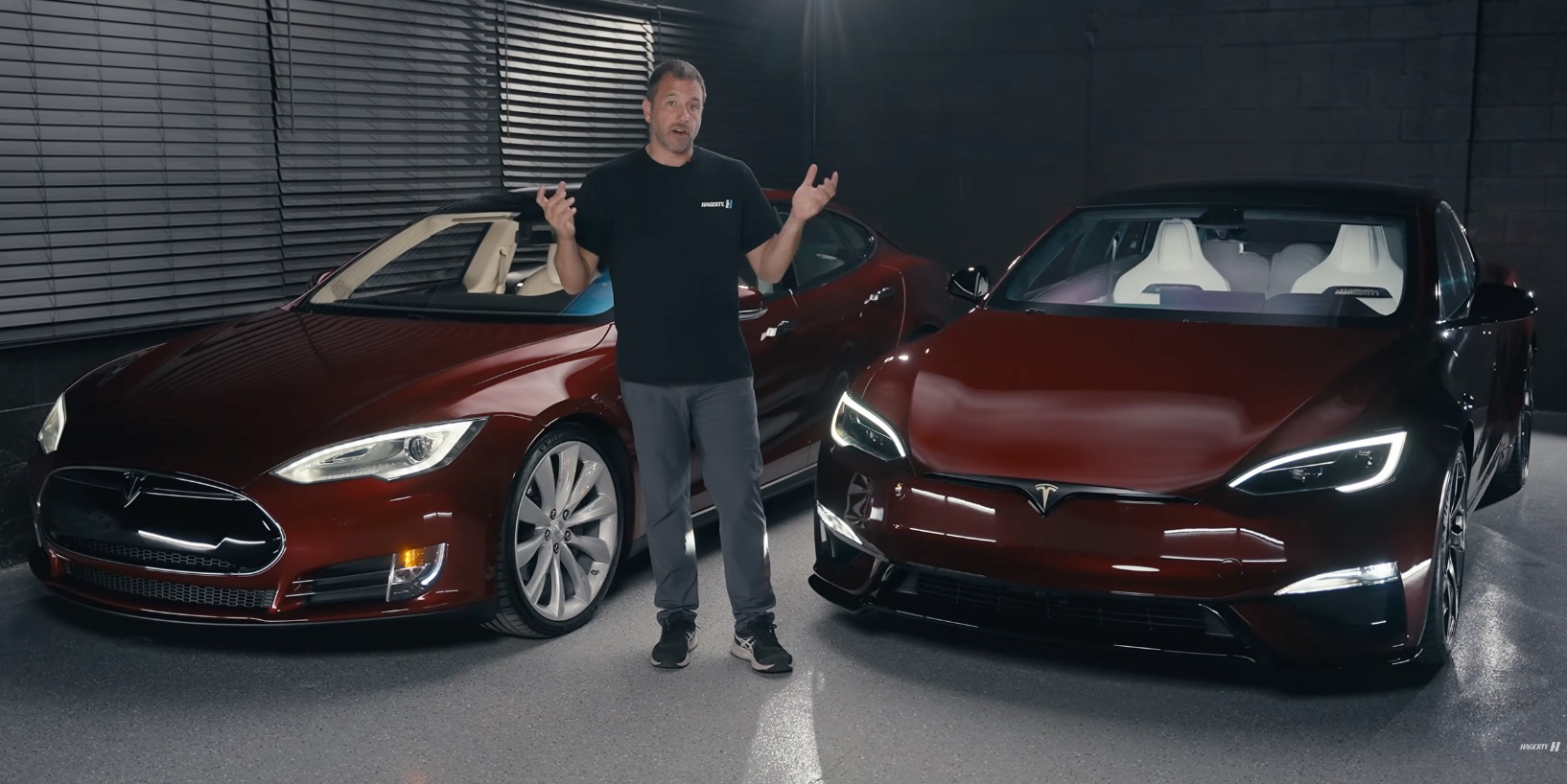
Tesla has recently unveiled the final Signature Edition of the Model S, marking the end of an era for this iconic electric vehicle. Auto journalist Jason Cammisa and Hagerty have praised the Model S for revolutionizing the automotive industry and predicting that it will ultimately lead to the demise of traditional gas-powered vehicles. Cammisa had the privilege of getting up close and personal with the final build of the Model S, paying tribute to its groundbreaking design and technology.
During its 14-year production run, the Model S underwent a remarkable transformation, evolving from a car with roughly 5,000 parts in 2012 to just 3,000 parts in the 2026 version. Only 3% of the parts in the latest Model S are shared with the original, a level of innovation that would typically take a conventional automaker six generations and 60 years to achieve. This rapid evolution was made possible by Tesla’s unique engineering approach, which allowed for continuous improvements and updates even after the car had entered production.
One of the key drivers of the Model S’s evolution was Tesla’s “battery buck” philosophy, which calculated the cost of adding new features against the cost of adding more battery capacity to maintain range. This approach led to significant weight reductions and efficiency improvements over the car’s lifetime, with the long-range Model S shedding 375 lbs and becoming 40% more efficient. Innovations like Sentry Mode, developed in just four days and deployed over-the-air, showcased Tesla’s agility and commitment to pushing the boundaries of automotive technology.
Cammisa fondly recalls his first road test of the Model S in 2012, where he encountered issues with the retracting door handles. However, a software update overnight fixed the problem, demonstrating Tesla’s dedication to continuous improvement and innovation. Despite early criticisms of build quality, the Model S quickly established itself as a game-changer in the electric vehicle market, offering a range of 265 miles that surpassed competitors like the Nissan Leaf. Features like over-the-air updates and a full touchscreen interface, developed internally because the iPad had not yet been released, set the Model S apart as a trailblazer in the industry.
In Cammisa’s view, the Model S is not just another car – it is a groundbreaking vehicle that has redefined what is possible in the automotive world. While traditional automakers have sometimes held back on their electric vehicle programs to protect their gas-powered business, Tesla has continued to innovate and push the boundaries of technology. Cammisa believes that companies that are now canceling their EV programs are sealing their own fate, as the Model S has already shown consumers a future of software-defined vehicles that constantly improve over time.
In conclusion, Cammisa asserts that the Model S is not just the most important car of the year, but the most important car America has produced in a lifetime. Its impact on the automotive industry and its role in shaping the future of electric vehicles cannot be overstated. As we bid farewell to the final Signature Edition of the Model S, we celebrate a vehicle that has truly changed the game and set a new standard for electric cars worldwide.