
Donut Lab, the Finnish startup that has been making waves in the electric vehicle industry, has recently released new details about the Verge TS Pro Gen2, the world’s first solid-state electric bike. The company claims to have developed production-ready solid-state batteries, but there is still skepticism surrounding the chemistry used in these batteries.
In a new video posted on Donut Lab’s YouTube channel, Ville Piippo, the co-founder and CTO of the company, delves into the battery configuration of the Verge TS Pro Gen2 motorcycle. This electric bike is not only the first of its kind to be powered by solid-state batteries but also boasts the title of the fastest-charging electric bike on the market.
Despite the claims made by Donut Lab about the solid-state batteries having an energy density of 400 watt-hours/kilogram, no rare-earth materials used, and a lifespan of 100,000 charge cycles, the company has yet to provide concrete evidence to support these assertions. The lack of patents, validation results, or a breakdown of the chemistry used in the cells has raised doubts among experts in the field.
However, diving into the technical details, the Verge TS Pro Gen2 comes in two versions: Standard Range and Long Range. The Standard Range model utilizes 192 of Donut Lab’s 94 Wh cells, resulting in a nominal capacity of around 18 kilowatt-hours, with a maximum capacity of approximately 20 kWh. The Long Range version offers roughly 30 kWh of nominal capacity within the same battery enclosure size as the smaller pack.
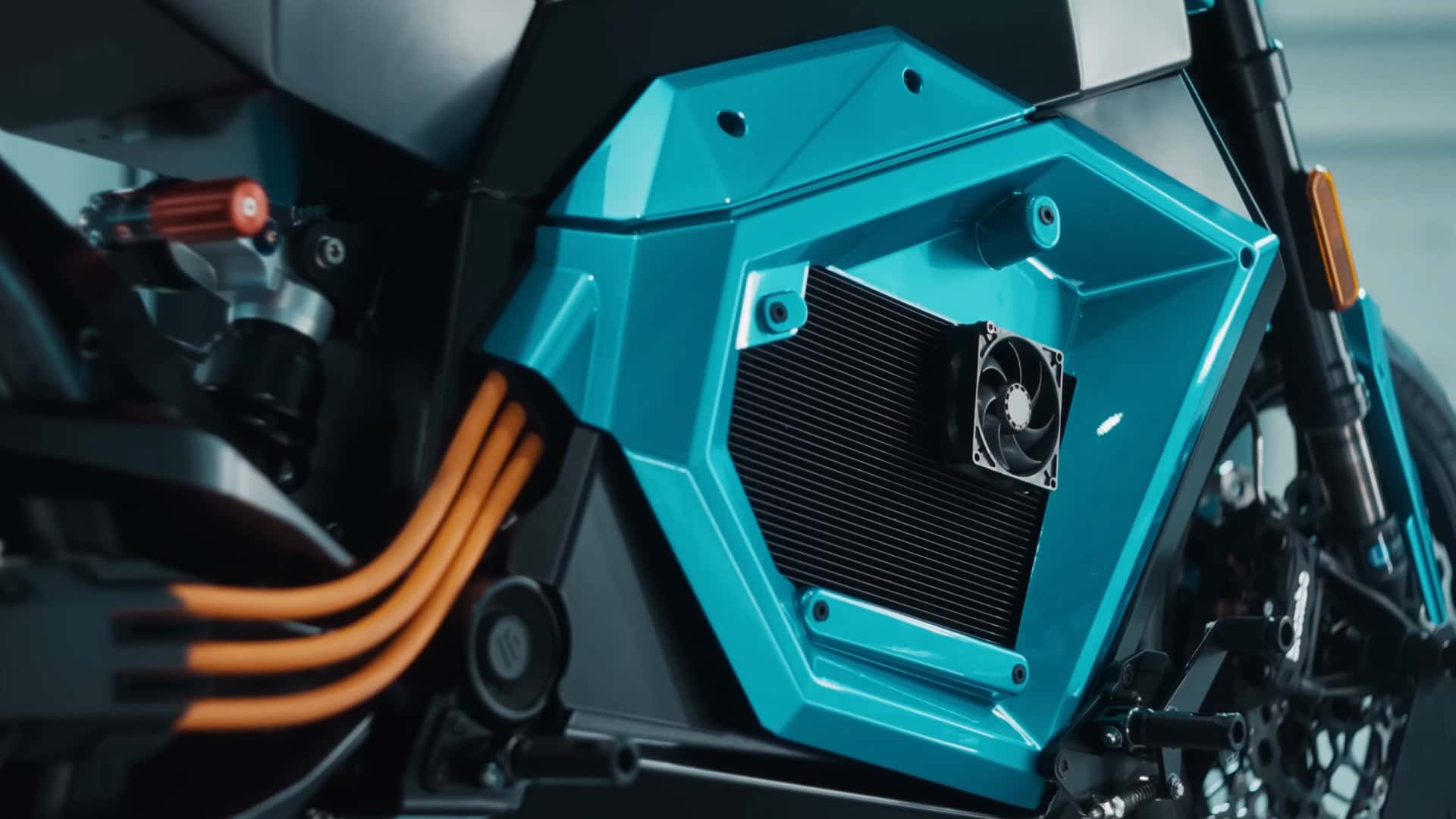
Each module in the 18 kWh model features a 2P 96S configuration (2 cells in parallel and 96 cells in series), resulting in a maximum system voltage of around 400V. The battery pack consists of four modules stacked on top of each other, with heat transfer plates between each cell layer to dissipate heat. The pack is air-cooled, with heat sinks and small fans on each side aiding in heat dissipation.
When it comes to charging, the Verge TS Pro Gen2 can reach peak charging power of around 100 kW with a DC fast charger, taking approximately 11 minutes to go from 10% to 80% and under 15 minutes for a 10% to 90% top-up. Donut Lab attributes the lower peak charging power compared to previous claims to the bike’s compact design, which does not allow for liquid cooling.
Despite the lower peak charging power, the Verge TS Pro Gen2 still boasts an impressive C-rate of over 5C, making it one of the fastest-charging motorcycles on the market. This C-rate refers to the rate at which a battery can charge or discharge relative to its maximum capacity, with most modern EV batteries having a C-rate of under 4C.
In conclusion, the Verge TS Pro Gen2 with Donut Lab’s solid-state battery is setting new standards in the electric bike industry with its fast-charging capabilities and innovative battery technology. While the skepticism surrounding the battery chemistry remains, the performance of the Verge TS Pro Gen2 is certainly turning heads in the EV world. The world is constantly evolving, and with that evolution comes new technologies, advancements, and innovations. One of the most significant advancements in recent years is the development of artificial intelligence (AI). AI has the potential to revolutionize countless industries, from healthcare to transportation to finance.
AI is essentially the ability of a machine to mimic human intelligence and perform tasks that typically require human intelligence, such as visual perception, speech recognition, decision-making, and language translation. This technology has the power to streamline processes, increase efficiency, and improve decision-making.
In the healthcare industry, AI is being used to diagnose diseases, personalize treatment plans, and improve patient outcomes. AI-powered tools can analyze medical images, such as X-rays and MRIs, to detect abnormalities and provide more accurate diagnoses. This can lead to earlier detection of diseases and more effective treatments.
In the transportation sector, AI is being utilized to improve safety and efficiency. Self-driving cars, for example, use AI algorithms to navigate roads, detect obstacles, and make decisions in real-time. This technology has the potential to reduce accidents and congestion on the roads.
In the finance industry, AI is being used to detect fraud, automate customer service, and make better investment decisions. AI-powered algorithms can analyze vast amounts of data to identify patterns and anomalies that may indicate fraudulent activity. This can help financial institutions protect their customers and reduce losses.
Overall, the potential applications of AI are vast and varied. From improving healthcare outcomes to enhancing transportation safety to revolutionizing finance, AI has the power to transform industries and improve lives. As technology continues to advance, it will be exciting to see how AI continues to shape the world around us.