
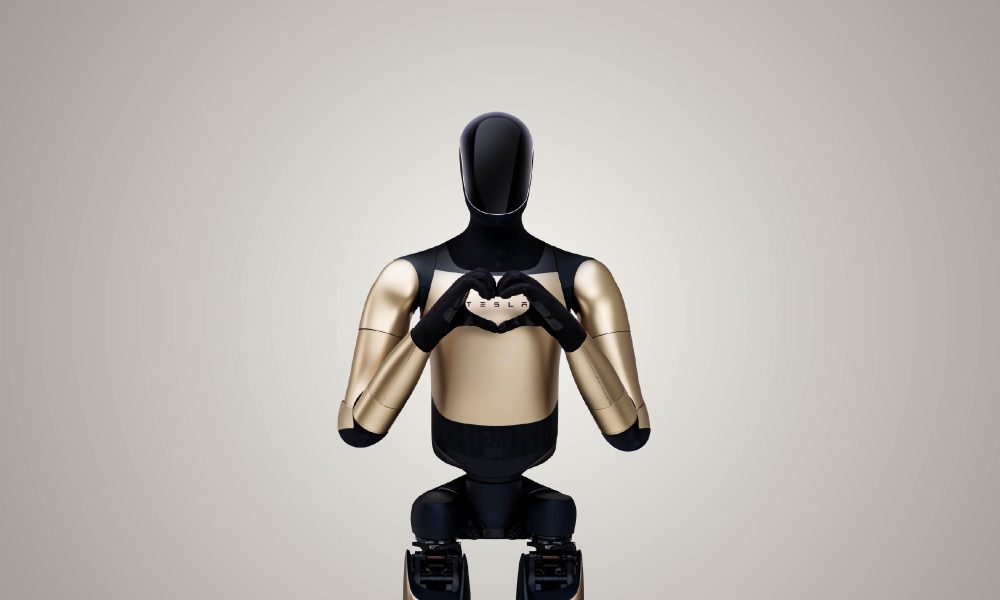
Tesla is on the brink of unveiling the latest version of its Optimus humanoid robot, complete with new patents for its hands and arms. The company filed two patents on the same day as the “We, Robot” event in October 2024, protecting Tesla’s mechanically actuated, tendon-driven architecture.
The primary patent, titled “Mechanically Actuated Robotic Hand,” outlines a cable/tendon-driven system with actuators located in the forearm rather than the hand. Each finger boasts four degrees of freedom, while the wrist adds two more. The design features three thin, flexible control cables per finger that extend from the forearm actuators, pass through the wrist, and connect to the finger segments. This setup closely mimics human forearm muscle and tendon anatomy, allowing for independent bending without unintended motion.
A standout feature of the design is the wrist’s cable transition mechanism, which significantly reduces cable stretch, torque, friction, and crosstalk during wrist movements. This innovation supports smoother, more reliable multi-axis wrist operation, crucial for complex real-world tasks.
Two supporting patents delve deeper into the appendage and joint design. “Robotic Appendage” covers the overall forearm-to-palm-to-finger assembly, while “Joint Assembly for Robotic Appendage” describes curved contact surfaces on mating structures paired with a flexible member for smooth pivoting and consistent tension.
Tesla executives have acknowledged the hand as the most challenging component of the Optimus robot. Elon Musk has described it as “the majority of the engineering difficulty” and compared it to the complexity of developing the Cybertruck and Model X. Despite initial struggles, Tesla has overcome hurdles related to human-level dexterity, AI integration, and production scalability.
The patents signal a shift towards a production-oriented system engineered from first principles. The 22-DoF architecture, forearm-driven tendons, and crosstalk-minimizing wrist give Optimus a competitive edge in dexterity. These solutions address key pain points and position Tesla as a leader in the race towards general-purpose robotics.
Overall, Tesla’s latest patents showcase the company’s ability to tackle complex engineering challenges and develop innovative solutions for humanoid robots like Optimus. The integration of these advancements will undoubtedly propel Tesla to the forefront of the robotics industry.