
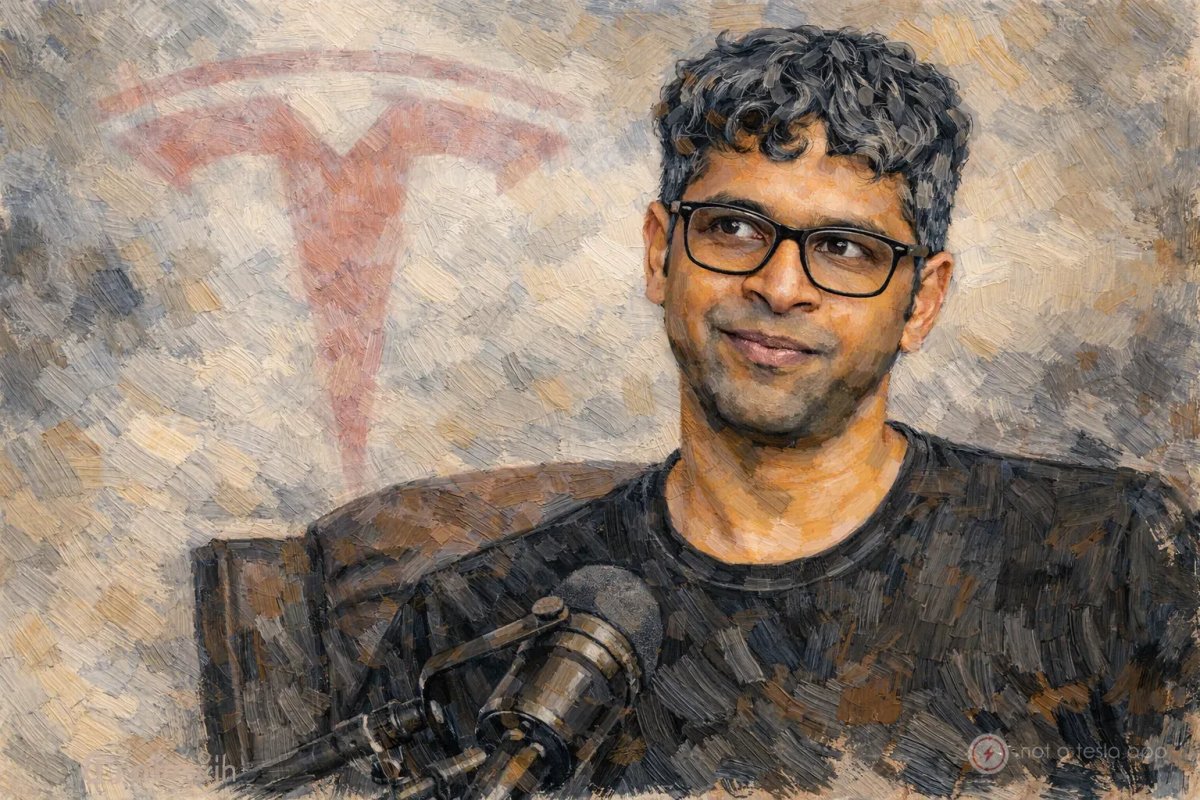
Get to Know the Mastermind Behind Tesla’s Autonomous Driving Vision: The Inspiring Journey of Ashok Elluswamy
Ashok Elluswamy, the VP of AI at Tesla and leader at Macrohard, is spearheading one of the most ambitious AI projects in history.
While Franz von Holzhausen designed the captivating hardware that captivated the world, Ashok is the genius behind teaching that hardware to perceive, analyze, and rationalize. From the initial version of Autopilot to the comprehensive neural networks introduced in FSD V12, his efforts are shaping the future of self-driving vehicles and robotics.
Roots in Robotics
Ashok’s journey commenced not in Silicon Valley, but in India, where he obtained his bachelor’s degree in Electronics and Communication Engineering from the Visvesvaraya National Institute of Technology.
His fascination with enabling machines to interact with the real world led him to the United States and to one of the world’s leading robotics institutions: Carnegie Mellon University. There, he earned a Master’s degree from the Robotics Institute, delving into the intricate challenges of computer vision and machine learning.
His early career involved tackling the fundamentals of autonomy within the traditional auto industry. He worked at WABCO Vehicle Control Systems and later at Volkswagen’s Electronics Research Lab, developing computer vision systems and driver assistance features. He was already delving into the realm of vehicle autonomy, but within the sluggish, incremental realm of conventional automakers, which entailed minor annual updates.
Embracing the Challenge
In 2014, Ashok made a pivotal decision. He departed from the established realm of legacy auto to join a company that was just starting to find its footing. He responded to a renowned post on X from Elon Musk, who was seeking to assemble a top-tier team to develop the world’s first genuine autopilot system for consumer vehicles.
Ashok was the initial engineer recruited for Tesla’s Autopilot team and continues to be at the core of the team to this day.
The monumental task he faced was unlike his previous roles. This endeavor was not about simply creating a single, isolated feature for the next model year. Instead, he was establishing a world-class software team entrusted with crafting an autonomous driving system from nearly scratch, under a CEO with an incredibly ambitious vision for full self-driving.
Empowering the Fleet with Vision
The initial outcome of that colossal effort was the original Autopilot, which astounded the world by introducing features like Autosteer and Traffic-Aware Cruise Control to a production vehicle. However, this was just the beginning. The team’s most significant challenge and breakthrough was the shift to Tesla Vision.
In a highly contentious move, Ashok’s team led the initiative to eliminate radar from Tesla’s sensor suite, contending that a system relying on two different sensor inputs (vision and radar) was fundamentally flawed.
They believed the only way to achieve general autonomy was to address vision first, mirroring human capabilities. This first-principles approach was met with skepticism but proved to be a crucial step, compelling the team to construct a more robust, camera-based system that could adapt across millions of vehicles and various environments worldwide. Ultimately, vision proved to be the correct move as it is significantly more trainable than technologies like LiDAR. Vision can be easily trained by exposing it to vast hours of human driving, a feat not easily achievable with LiDAR or radar.
The Evolution to End-to-End
Ashok’s tenure culminates in perhaps the most substantial architectural leap in FSD’s history: FSD V12. As a prominent speaker at Tesla’s AI Day events, he elucidated this transition to the world. Instead of hundreds of thousands of lines of C++ code dictating how the car should navigate specific scenarios, V12 is an “end-to-end” neural network.
It processes video from the car’s cameras and directly outputs driving commands, learning to drive by observing millions of hours of real-world video data.
This mirrors the software equivalent of Franz’s Cybertruck – a complete departure from convention, replacing a complex set of rules with a single, potent, learning-based AI. It is the foundational technology that underpins all of Tesla’s aspirations regarding AI and autonomy, particularly Robotaxi and Optimus.
Ashok Elluswamy’s legacy at Tesla transcends mere software updates; it encapsulates the meticulous, methodical, and brilliant execution of a strategy to tackle one of the most formidable challenges globally. He is the understated architect shaping the intellect of the machine.