
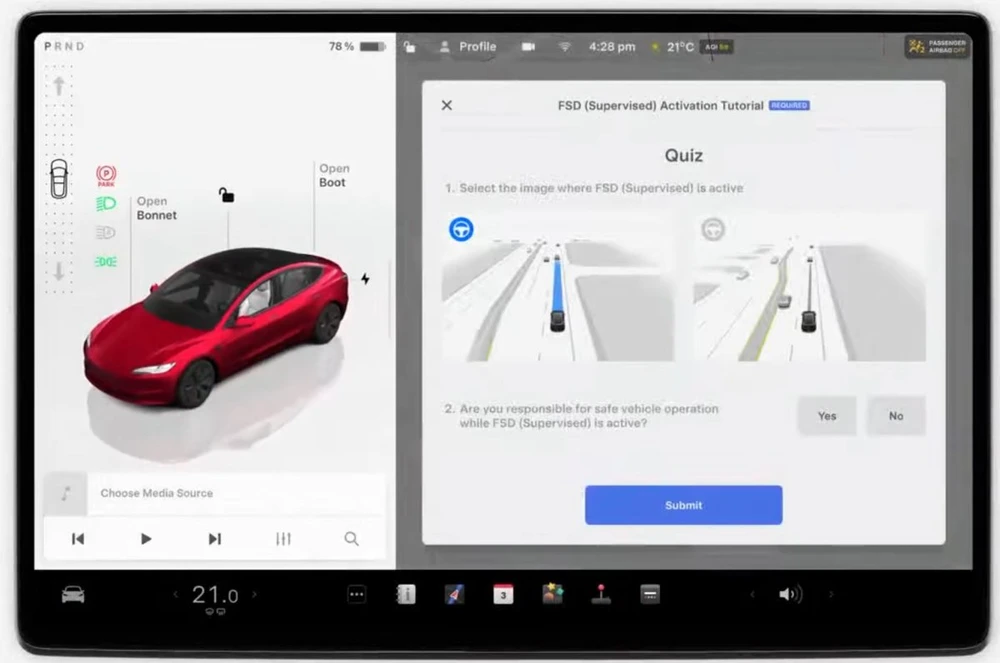
Tesla recently achieved a significant milestone by securing its first European approval for its Full Self-Driving (FSD) system. The Dutch regulators granted permission for Tesla’s self-driving software to be used on highways and city streets with a human driver present. This approval comes after 18 months of testing and evaluation by the Dutch vehicle authority RDW.
The Full Self-Driving Supervised system, which includes capabilities such as steering, braking, and acceleration, received positive feedback from RDW for its potential impact on road safety. RDW also announced plans to submit an application for the technology to be used throughout the European Union.
It is important to note that the European version of Tesla’s FSD is not identical to the software used in the United States. According to RDW, the software versions and functionalities in the US and Europe are not directly comparable. The European version has to meet stricter safety requirements imposed by EU vehicle approval standards.
Despite the differences, Tesla is excited about the approval and intends to introduce FSD Supervised to more European countries soon. The company plans to start rolling out the technology in the Netherlands in the near future.
The widespread adoption of full self-driving technology is a crucial part of Tesla’s long-term growth strategy. CEO Elon Musk believes that AI-driven autonomous software and robotaxis will play a significant role in generating revenue for the company. However, Tesla’s shares have experienced a decline of nearly 22% year-to-date.
To track the rollout of FSD in the European Commission, a website has been set up to provide updates on deployment and regulatory issues. Users can visit the site to stay informed about the latest developments in the European market regarding Tesla’s Full Self-Driving system.
Overall, Tesla’s approval for its FSD system in Europe marks a significant step forward in the company’s journey towards autonomous driving technology. With plans to expand its presence in the EU, Tesla is poised to make a lasting impact on the future of transportation.