
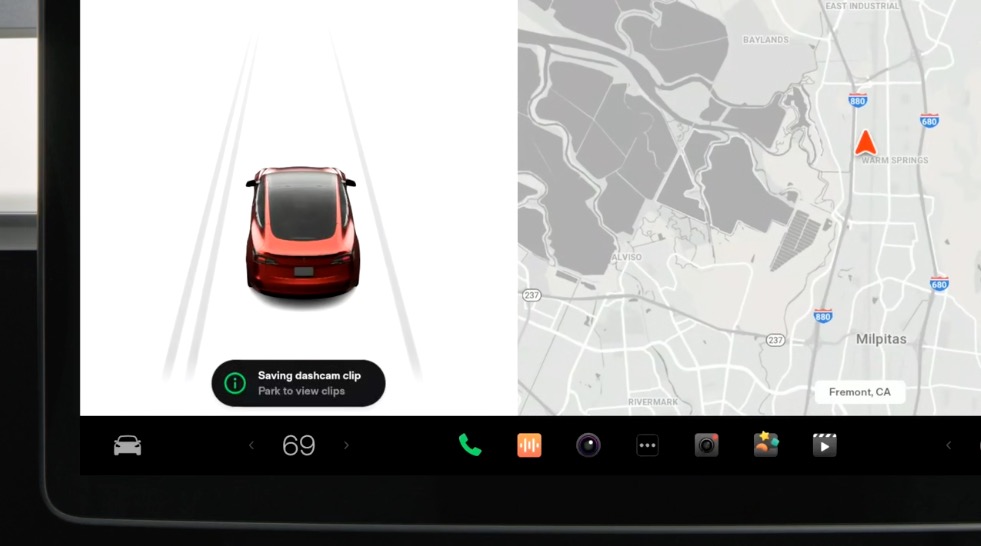
Tesla is making a significant improvement to its Dashcam feature by expanding the rolling recording buffer, addressing a long-standing grievance for owners. Until now, Tesla vehicles were limited to just 60 minutes of rolling footage, regardless of the storage capacity of the connected USB drive. This often led to the loss of crucial evidence if an owner didn’t manually save a clip immediately after an incident.
However, according to recent release notes for an upcoming software update, Tesla is introducing a dynamic recording system that scales the “Recent Clips” buffer based on the total capacity of the storage device. Owners using a standard 128GB drive can now expect to retain about 3 hours of footage, while those with a 1TB SSD or larger will see the limit increase to a massive 24 hours.
This update is a game-changer for owners who may not notice minor damages like door dings or scuffs until later. With the new and improved Dashcam feature, more video footage will be retained for review before the loop starts over.
This upgrade follows recent improvements to the Dashcam features, including the rollout of pinch-to-zoom and pan support to the Dashcam Viewer last month. Additionally, with December’s 2025 Holiday Update, Tesla introduced new overlays for speed, steering angle, and self-driving state to enhance the overall user experience.
The upcoming upgrade exemplifies Tesla’s commitment to utilizing over-the-air updates to introduce new features and enhance existing ones for its global fleet. While dynamic recording is currently being rolled out to employees in China, it is expected to reach North American owners in the coming weeks.
To fully utilize the 24-hour recording window, it is essential to ensure that the connected drive meets Tesla’s sustained write speed requirements of 4 MB/s. High-quality portable SSDs like the Samsung T7 are recommended for handling the constant data throughput and temperature fluctuations inside a parked car.
In conclusion, Tesla’s expansion of the Dashcam rolling recording buffer is a significant step towards improving the overall user experience and providing owners with more comprehensive video coverage for added security and peace of mind. The world of technology is constantly evolving, with new advancements and innovations being made every day. One of the most exciting developments in recent years has been the rise of artificial intelligence (AI) and machine learning. These technologies have the potential to revolutionize industries across the board, from healthcare to finance to transportation.
AI refers to the ability of machines to perform tasks that normally require human intelligence, such as visual perception, speech recognition, decision-making, and language translation. Machine learning, a subset of AI, involves training algorithms to learn from data and make predictions or decisions based on that data.
One of the key benefits of AI and machine learning is their ability to automate tasks that would normally require human intervention. This can lead to increased efficiency, cost savings, and improved accuracy. For example, in the healthcare industry, AI algorithms can analyze medical images to detect diseases such as cancer more quickly and accurately than a human doctor. In the finance industry, AI-powered chatbots can provide customer service and support 24/7, reducing the need for human agents.
Another key benefit of AI and machine learning is their ability to analyze vast amounts of data and identify patterns or trends that would be impossible for humans to discern. This can lead to more informed decision-making and better outcomes in a variety of fields. For example, in the transportation industry, AI algorithms can analyze traffic patterns and optimize routes to reduce congestion and improve efficiency.
However, with these benefits also come challenges and concerns. One of the biggest concerns surrounding AI and machine learning is the potential for bias in algorithms. If algorithms are trained on biased data, they can perpetuate and even exacerbate existing biases in society. For example, AI-powered hiring tools have been found to discriminate against certain groups based on race or gender.
There are also concerns about the impact of AI and machine learning on the job market. While these technologies have the potential to create new jobs and industries, they also have the potential to automate jobs that are currently performed by humans. This could lead to job displacement and a widening wealth gap between those who have the skills to work with AI and those who do not.
Despite these challenges, the potential of AI and machine learning to revolutionize industries and improve our daily lives is undeniable. As these technologies continue to advance, it will be important for policymakers, businesses, and society as a whole to work together to ensure that AI is used responsibly and ethically. Only then can we fully reap the benefits of this exciting new frontier in technology.