
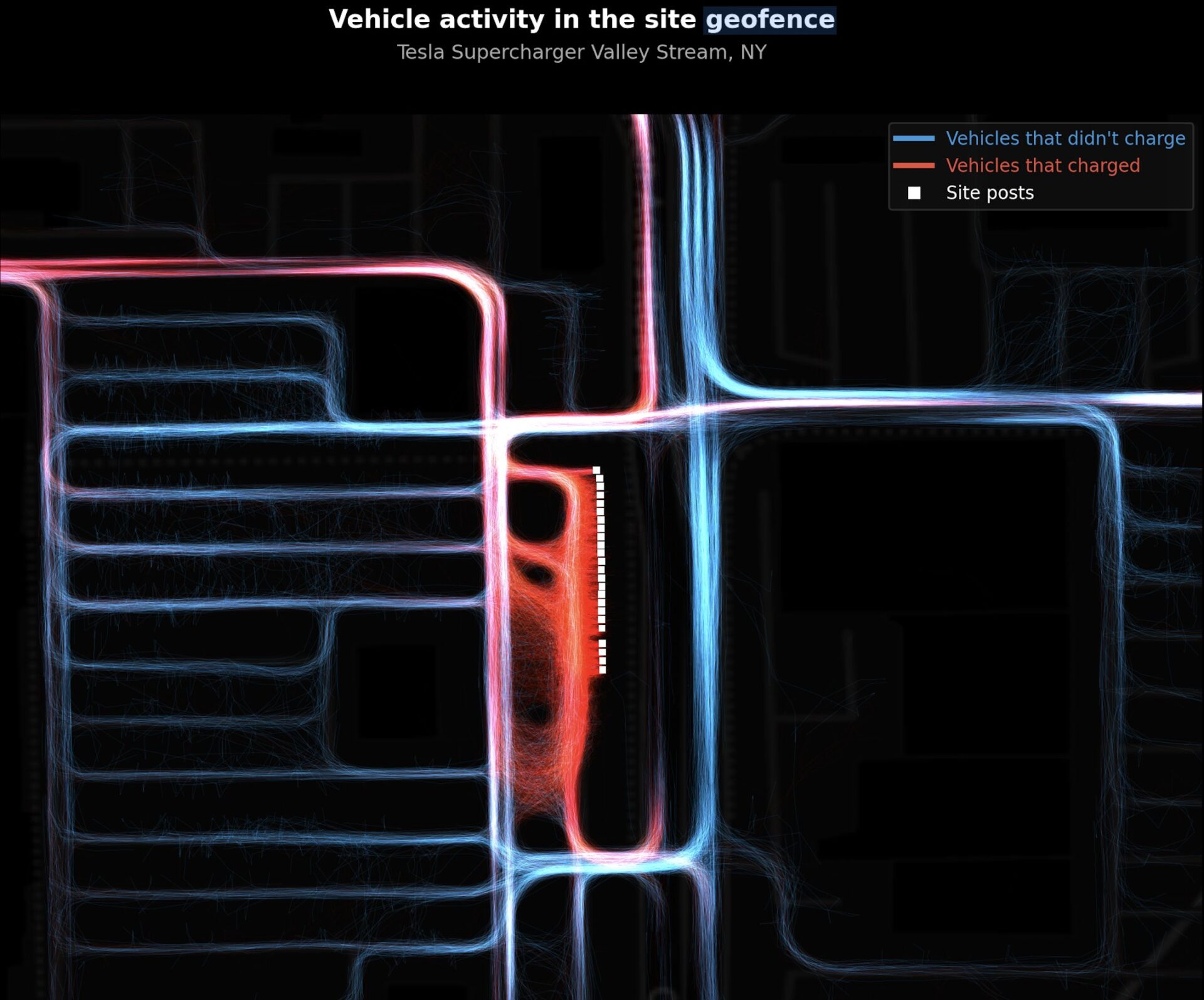
Tesla is revolutionizing its Supercharger forecasting system to provide drivers with more accurate wait-time estimates. The Tesla Charging team is dedicated to creating a network where waiting is nearly non-existent, and when queues do occur, drivers can rely on precise data to plan their trips confidently. The company’s Trip Planner already optimizes travel time by selecting the best charging sites, but a new machine learning model is being implemented to address the challenge of “mixed-purpose traffic” at co-located amenities.
Superchargers are often situated near malls or restaurants, making it difficult for previous systems to differentiate between a Tesla owner parking for a meal and one intending to charge. To combat this issue, Tesla has trained a new model on 9 million miles of aggregated and anonymized vehicle trajectory data within Supercharger geofences worldwide. This enhanced system can now better identify vehicles with an actual intent to charge, reducing queue length estimation errors by 20 percent. This means that even in scenarios where more than 10 vehicles are waiting, the system can predict the queue with an error of only one or two cars.
Tesla credits this level of intelligence to its vertical integration, allowing seamless communication between the vehicle software and charging hardware. By monitoring real-time traffic and predicting the number of vehicles heading towards a specific site, the Trip Planner can optimize routes and provide accurate expectations for the entire journey. While this latest release represents a significant improvement in forecasting, Tesla is already working on the next iteration to further enhance these estimates and perfect the charging experience.
With these advancements in Supercharger forecasting, Tesla is setting a new standard for efficient and convenient electric vehicle charging. Drivers can now rely on precise wait-time estimates to plan their journeys with ease, knowing that Tesla is constantly working to refine and improve the charging experience for all users.