
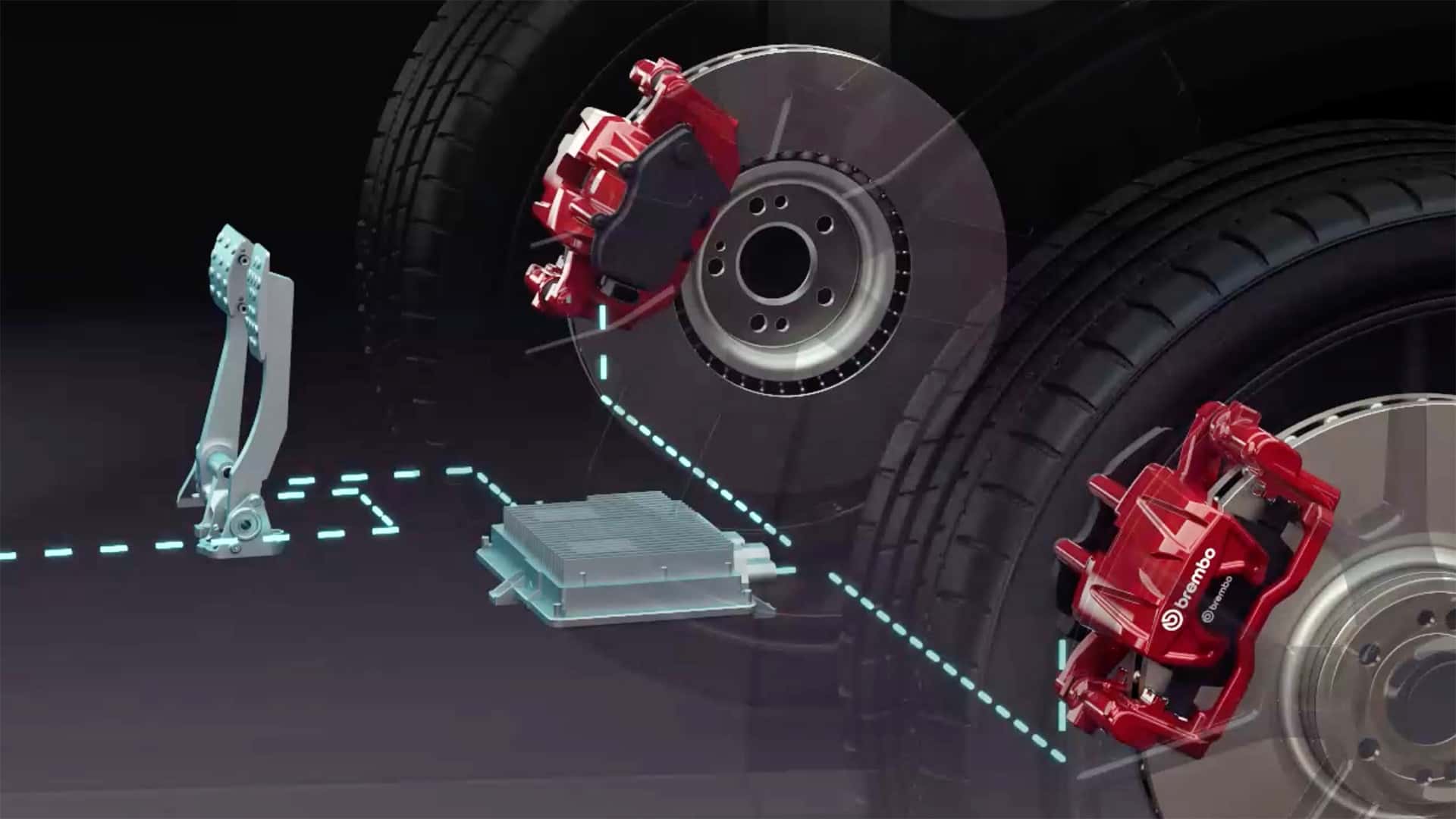
Brembo, a renowned brake manufacturer, has introduced a groundbreaking innovation in the world of automotive braking systems. Their latest creation, Brembo Sensify, is set to revolutionize the way cars brake by eliminating brake fluid and allowing software to control braking force at each wheel. This means that the brake pedal, which traditionally served as a direct mechanical command to engage the brakes, now becomes an input device that communicates with a computer to slow the vehicle down.
In a conventional braking setup that has been in use for over a century, pressing the brake pedal initiates the movement of hydraulic fluid through lines that actuate the calipers. However, Brembo’s Sensify system operates differently. By utilizing electrical signals and actuators in each caliper, the system can engage the brake pads, grip the brake rotor, and decelerate the vehicle without the need for hydraulic fluid. This electromechanical setup allows for more precise braking at each wheel compared to traditional hydraulic systems.
One of the key advantages of Brembo Sensify is its ability to modulate braking forces accurately and continuously, supporting stable and controlled vehicle behavior in various driving conditions. This innovative system enhances peace of mind for drivers by ensuring a smooth and predictable braking experience. Additionally, Sensify is designed to support a wide range of advanced vehicle architectures, from next-generation driver assistance systems to fully autonomous applications.
The implementation of Brembo Sensify in electric vehicles (EVs) holds significant promise. As EVs increasingly rely on regenerative braking to slow down and recharge the battery, the need for traditional friction brakes is reduced. By incorporating stronger regenerative braking capabilities, Sensify could potentially make friction brakes smaller, smoother, and longer-lasting in EVs.
Overall, Brembo’s Sensify represents a leap forward in automotive braking technology. With its innovative fluid-free architecture and intelligent control system, this system is poised to redefine the way cars brake and pave the way for a new era of software-driven vehicles. Electric vehicles (EVs) are revolutionizing the automotive industry with their efficient performance and eco-friendly features. One key advantage of EVs is their regenerative braking system, which not only helps in improving energy efficiency but also extends the life of brake pads. In traditional vehicles, braking generates heat and friction, causing wear and tear on brake pads over time. However, in EVs, regenerative braking harnesses the kinetic energy produced during braking and converts it back into usable electricity, reducing the reliance on traditional friction brakes.
The use of regenerative braking in EVs can significantly increase the lifespan of brake pads. Since regenerative braking is the primary method of slowing down an EV, the traditional brake pads are used less frequently, resulting in reduced wear and tear. This means that EV owners may not need to replace their brake pads as often as owners of traditional internal combustion engine vehicles.
Furthermore, the integration of regenerative braking can also improve the overall performance of EVs. By utilizing regen more frequently, EVs can maximize their energy efficiency and range. This is particularly beneficial in stop-and-go traffic or urban driving conditions where frequent braking is required. The regenerative braking system captures the energy that would otherwise be lost as heat during braking and stores it in the battery for later use. As a result, EVs can go further on a single charge and reduce their energy consumption.
Overall, regenerative braking is a game-changer for EVs, offering both environmental benefits and cost savings for owners. By reducing the wear and tear on brake pads and maximizing energy efficiency, regenerative braking is a key feature that sets EVs apart from traditional vehicles. As technology continues to advance, we can expect to see further improvements in regenerative braking systems, making EVs even more efficient and sustainable in the future.