
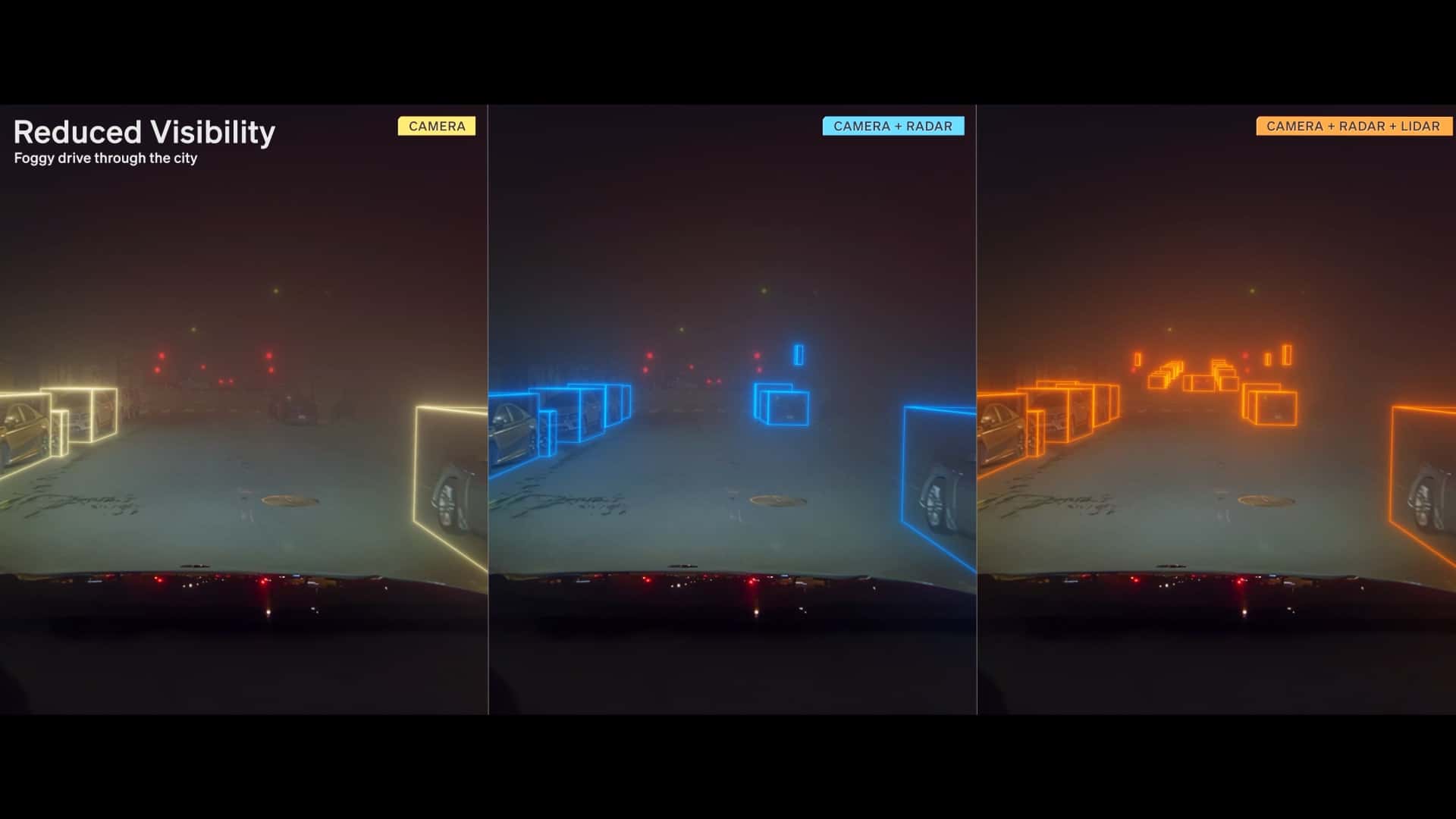
But it’s still not enough to detect the pedestrian until it’s almost too late. However, when lidar is added into the mix, it’s able to detect the pedestrian much earlier and more accurately, potentially preventing an accident.
This video demonstration clearly shows why lidar could be a game-changer for autonomous driving. While cameras and radar have their uses, they have limitations that lidar can overcome. With the cost of lidar decreasing and the technology improving, it’s becoming a more viable option for automakers looking to enhance their autonomous driving capabilities.
Rivian’s decision to include lidar in the R2 at such an affordable price point is a bold move that may set them apart from competitors who are sticking to camera-only systems. As the race towards full autonomy continues, it will be interesting to see how other automakers respond to Rivian’s innovation and whether lidar becomes a standard feature in future autonomous vehicles.
Whether or not lidar is truly necessary for autonomous driving remains to be seen. But as technology continues to advance and improve, it’s clear that having more sensors to perceive the world around them can only benefit autonomous vehicles in the long run.
However, it is evident that lidar technology is playing a crucial role in enhancing the capabilities of autonomous vehicles. Lidar, which stands for Light Detection and Ranging, uses laser beams to create a detailed 3D map of the surrounding environment. This allows the autonomous vehicle to detect objects with precision and accuracy, even in challenging lighting conditions.
The ability of lidar to detect people walking along a poorly lit highway at night highlights its superiority over camera-only systems. While the camera system struggles to pick up the pedestrians until they are right in front of the car, the lidar system can identify them from a greater distance. This early detection capability is essential for ensuring the safety of both passengers and pedestrians on the road.
The integration of lidar technology into autonomous vehicles is revolutionizing the way these vehicles perceive and interact with their surroundings. By providing a detailed and accurate view of the environment, lidar enables autonomous vehicles to make informed decisions in real-time. This not only enhances the safety of autonomous driving but also improves the overall efficiency and performance of these vehicles.
While it remains unclear which specific cameras, radar systems, or lidar technology Rivian is utilizing in their example, the importance of lidar in the AV space is undeniable. As autonomous vehicles continue to evolve and become more prevalent on our roads, the role of lidar technology will only become more significant. Its ability to see and understand the world around it better than a human can is a game-changer for the future of transportation.