
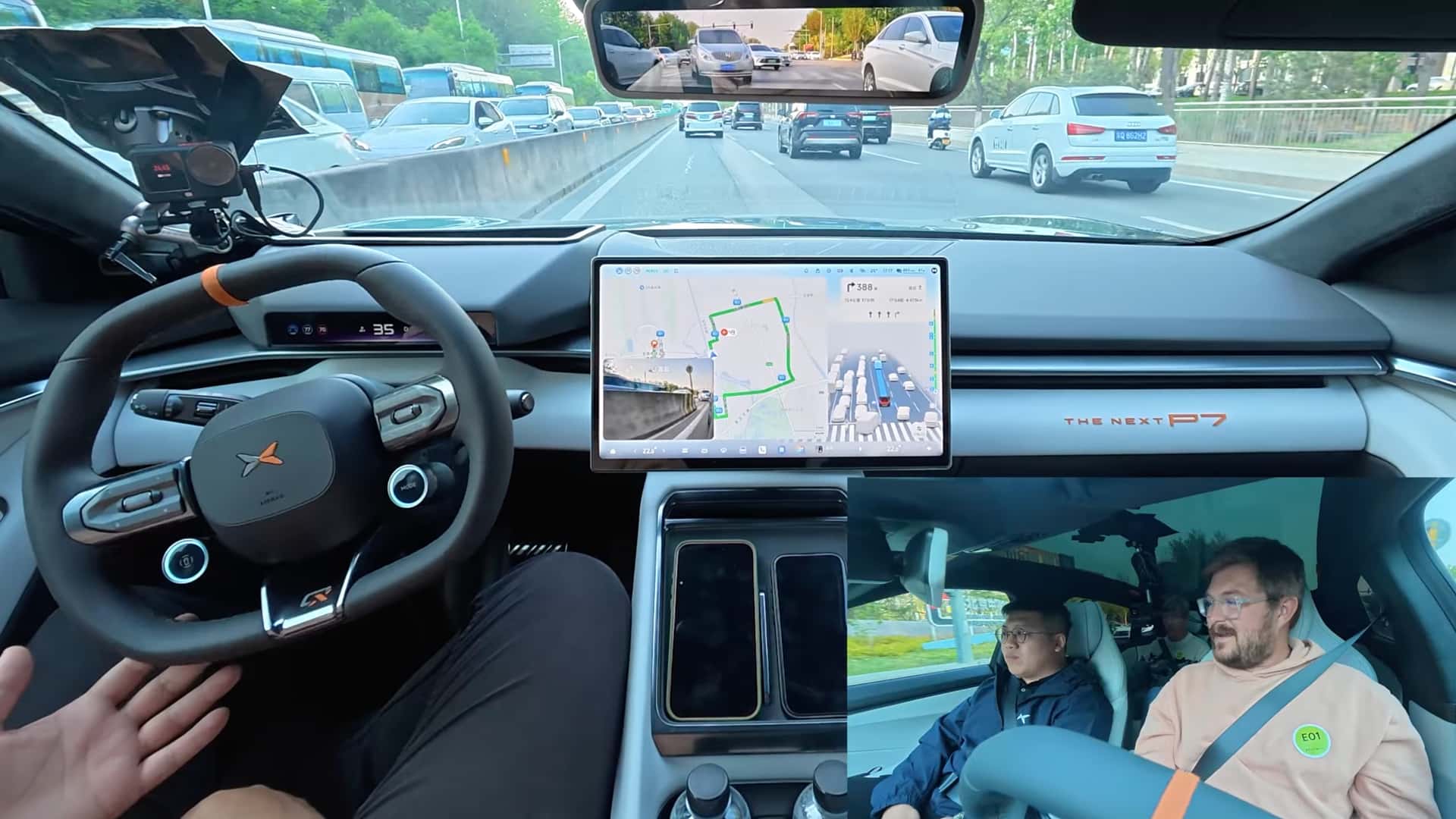
Xpeng’s VLA 2.0 is making waves in the world of advanced driver assistance systems, positioning itself as a strong competitor to Tesla’s Full Self-Driving technology. While it may not yet match the overall capability of Tesla’s system, Xpeng’s VLA 2.0 is smooth and confident in its performance.
One of the key differences between VLA 2.0 and Tesla’s Full Self-Driving is Xpeng’s use of a “generative world model” that simulates driving scenarios to develop the system before deployment. This approach has allowed Xpeng to expand its autonomous driving simulation scenarios significantly, providing a daily equivalent of 30 million kilometers of real-world driving.
Despite its impressive simulation capabilities, the real test for VLA 2.0 lies in its performance on the road. Early reviews from Western journalists who experienced the system in Beijing traffic were positive, highlighting its smooth handling of lane changes and confident navigation through busy traffic situations. However, there are concerns about its ability to react in emergency situations, as these scenarios were not fully tested during the initial ride-along.
Xpeng’s VLA 2.0 stands out for its reliance on cameras over radar or lidar, aligning with Tesla’s approach to sensor technology. This shift away from lidar, which Xpeng previously used in its vehicles for driver assistance, demonstrates the company’s commitment to advancing camera-based systems.
In a comparison with Tesla’s Full Self-Driving in China, VLA 2.0 was praised for its smoothness and assertiveness on the road. It handled traffic situations confidently and seamlessly, although there were instances where it appeared overly reliant on lead cars and hesitant in certain maneuvers.
Overall, Xpeng’s VLA 2.0 represents a significant step forward in China’s autonomous driving technology landscape. As the system continues to evolve and improve, it has the potential to challenge established players like Tesla and accelerate China’s position as a leader in advanced driver assistance systems. Tesla has long been considered a leader in advanced driver assistance systems, with their Autopilot technology setting the standard for semi-autonomous driving capabilities. However, it seems that the competition is heating up, and it may only be a matter of time before something, most likely from China, surpasses Tesla in this field.
Tesla’s Autopilot system uses a combination of cameras, radar, and sensors to enable features such as lane-keeping assistance, adaptive cruise control, and automatic lane changes. While Tesla has made significant strides in this area, other automakers and tech companies are also investing heavily in developing their own advanced driver assistance systems.
One of the key players to watch is Chinese tech giant Baidu, which has been making rapid advancements in autonomous driving technology. Baidu’s Apollo platform is an open-source software platform that provides developers with the tools they need to build their own autonomous driving systems. With partnerships with major automakers like Ford and BMW, Baidu is positioning itself as a serious contender in the race to develop the next generation of driver assistance systems.
Another Chinese company to keep an eye on is NIO, an electric vehicle manufacturer that has been gaining traction in the market. NIO’s advanced driver assistance system, known as NIO Pilot, offers features similar to Tesla’s Autopilot and has received positive reviews for its performance and reliability.
While Tesla still holds the lead in advanced driver assistance technology, the competition is fierce, and it’s clear that other players are quickly closing the gap. As more companies enter the race to develop the most advanced driver assistance systems, consumers can expect to see a wider range of options available in the near future.
In conclusion, while Tesla may currently have the lead in advanced driver assistance technology, it’s only a matter of time before something, most likely from China, surpasses it. With companies like Baidu and NIO making significant advancements in this field, the future of autonomous driving looks promising, with a wide range of options available to consumers.