
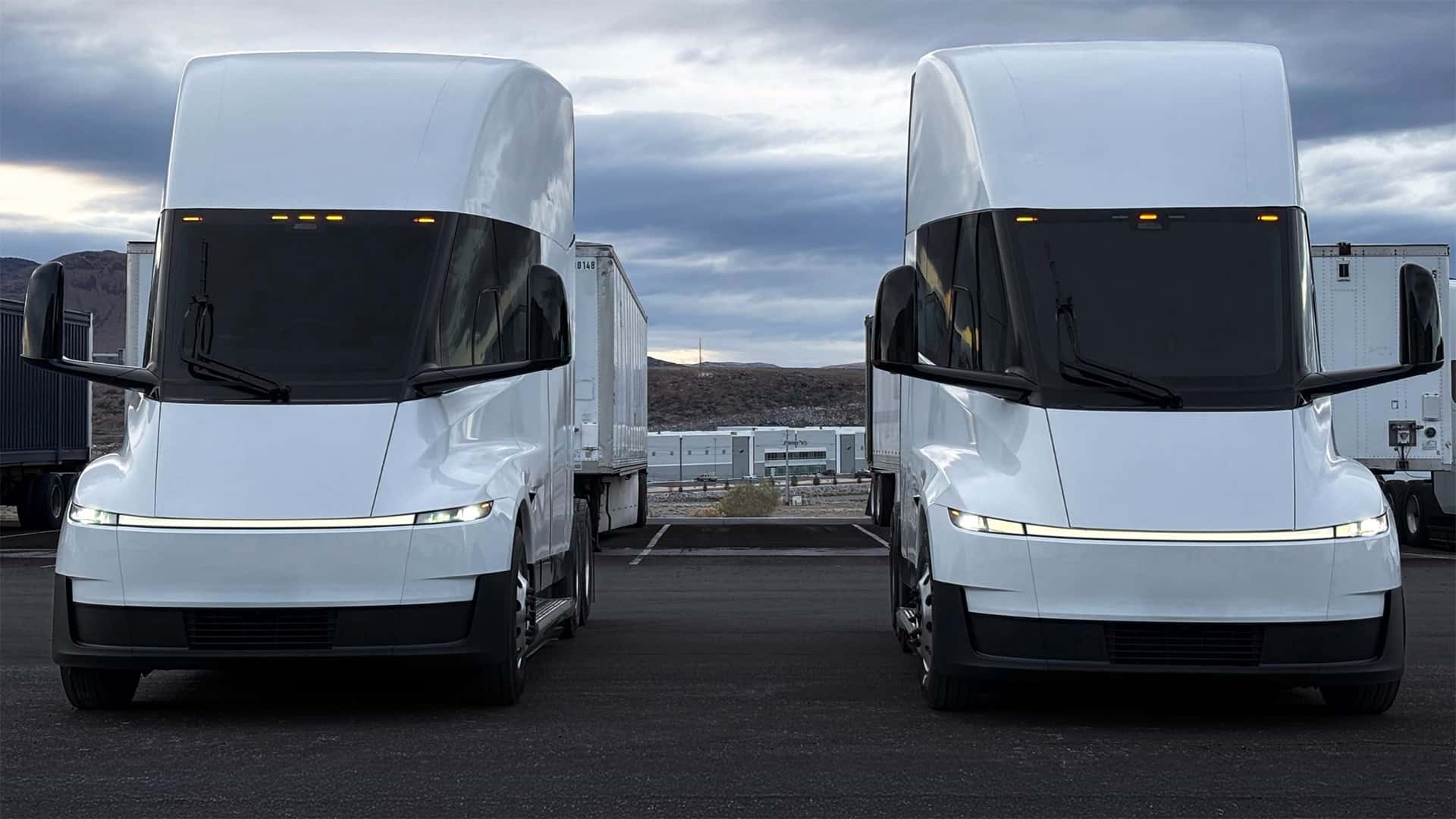
The Tesla Semi is once again making headlines, this time thanks to a video published by Jay Leno on YouTube showcasing the latest features of the Class 8 truck. During the video, Dan Priestly, the Semi’s program director, and Franz von Holzhausen, Tesla’s head of design, revealed that an automated charging system is in the works for the megawatt-capable truck.
Currently, the Tesla Semi can accept up to 1.2 megawatts through a liquid-cooled cable. However, the company is developing alternative solutions to make charging even easier for drivers and fleet managers. Priestly mentioned, “We see an opportunity for doing automated charging in the future,” while Holzhausen added, “It’s something we’re working on with the cars,” hinting at a wireless charging system similar to the one in the upcoming Cybercab two-seater.
It is unclear whether the automated charging system will involve a charging pad or a system that automatically plugs a cable into the charge port. If an inductive charging solution is in the works, it may be reserved for longer rest stops as charging speeds on wireless connections are typically slower than wired connections.
Wave Charging, a Utah-based company, claims that its wireless charging system can deliver up to 500 kW of power through a floor-mounted pad. In 2021, the company announced that it was developing a solution for the Tesla Semi that could deliver up to 1 MW of power without a physical connection between the charger and the vehicle.
Tesla’s history with wireless chargers has not been successful so far. The automaker teased a solution for EV owners with garage access in 2023, but nothing came to fruition. With the development of an automated charging system for the Tesla Semi, the company aims to take the hassle out of charging the electric truck and make the process more convenient for drivers and fleet operators. A New Dawn: The Rise of Artificial Intelligence
In recent years, artificial intelligence (AI) has made immense strides in technology and innovation, leading to a new era of possibilities and opportunities. The rise of AI has opened up a world of endless potential, revolutionizing industries and transforming the way we live and work.
One of the key drivers behind the rise of AI is the increasing availability of data. With the proliferation of digital devices and the internet, massive amounts of data are being generated every day. AI algorithms are able to analyze and interpret this data at lightning speed, providing valuable insights and driving decision-making processes.
AI is also becoming more accessible and affordable, thanks to advancements in computing power and cloud technology. This has enabled businesses of all sizes to leverage AI tools and solutions to improve efficiency, productivity, and customer experience. From predictive analytics to natural language processing, AI is being used in a wide range of applications across various industries.
One of the most exciting developments in AI is the emergence of deep learning and neural networks. These advanced AI models are inspired by the structure and function of the human brain, enabling machines to learn from data and make decisions on their own. Deep learning has led to breakthroughs in areas such as image recognition, speech synthesis, and autonomous driving.
AI has also made significant strides in the field of healthcare. From diagnosing diseases to personalized treatment plans, AI is revolutionizing the way healthcare is delivered. AI-powered tools are able to analyze medical images, predict patient outcomes, and even assist in surgical procedures, leading to improved patient care and outcomes.
In the world of finance, AI is being used to detect fraud, optimize trading strategies, and personalize financial services. By analyzing vast amounts of data in real-time, AI algorithms can identify patterns and trends that human analysts may overlook, leading to more accurate and informed decisions.
As AI continues to evolve and mature, ethical considerations are becoming increasingly important. Issues such as bias in AI algorithms, data privacy, and job displacement are all topics of discussion in the AI community. It is crucial for policymakers, industry leaders, and researchers to work together to ensure that AI is developed and deployed responsibly and ethically.
In conclusion, the rise of artificial intelligence is ushering in a new era of innovation and advancement. From healthcare to finance, AI is transforming industries and reshaping the way we live and work. With continued investment and collaboration, AI has the potential to drive economic growth, improve quality of life, and solve some of the world’s most pressing challenges. The future is bright for AI, and the possibilities are truly endless.