
Ionna, the EV fast charging network that has been making waves in the industry, is expanding rapidly. The company recently celebrated its second anniversary and marked a significant milestone by opening its 100th EV charging station in the United States. Backed by several major automakers and using 400-kilowatt DC fast chargers exclusively, Ionna is at the forefront of the electric vehicle charging infrastructure revolution.
One of the key reasons behind Ionna’s rapid expansion is its adoption of lightning-fast building techniques. Traditional DC fast charging stations typically require weeks or even months of construction, which can hinder the company’s growth plans. However, Ionna has found a solution in a company that has managed to drastically reduce construction time to less than a week.
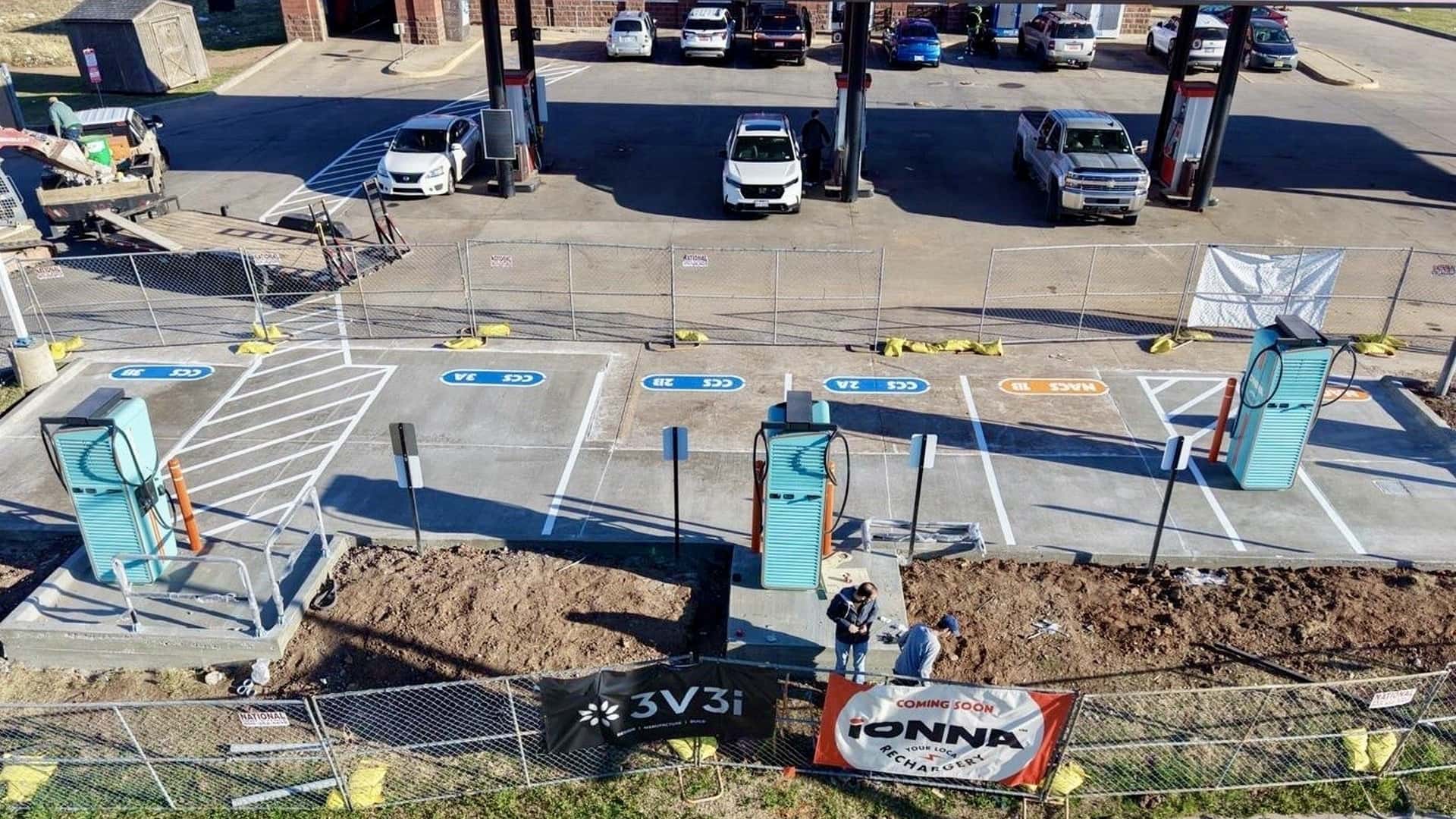
In a recent project in Oklahoma City’s Bricktown district, Ionna’s partner, 3V3i, successfully completed the construction of a new fast charging station in just five business days. This impressive feat is half the time compared to 3V3i’s previous record and sets a new benchmark for the industry. The construction company utilized a combination of prefabricated charging infrastructure components, integrated engineering and construction design, and a streamlined installation process to achieve this remarkable turnaround time.
According to a spokesperson from 3V3i, the speed of deployment is a significant challenge in expanding EV infrastructure. The company’s prefab manufacturing model enables charging networks to significantly reduce construction timelines, lower project costs, and bring charging capacity online faster.
While the construction of the Oklahoma City station was completed in just five days, the station itself is not yet operational. The site features three individual Alpitronic HYC400 stalls on the ground, offering four CCS connectors and two NACS cables. These dispensers come equipped with power electronics, eliminating the need for a separate power cabinet. Although the station is not yet listed on Ionna’s website and is marked as “Coming Soon” on PlugShare, it is expected to go online in the near future.
Ionna has ambitious expansion plans and has already energized nearly 1,000 bays since launching its first DC fast chargers in December 2024. This year alone, the company has brought 212 charging bays online, demonstrating its commitment to providing convenient and efficient charging solutions for electric vehicle owners. With its innovative building techniques and strategic partnerships, Ionna is poised to continue its rapid growth and play a pivotal role in shaping the future of EV charging infrastructure. The world of technology is constantly evolving, with new innovations and advancements being made every day. From artificial intelligence to virtual reality, there is no shortage of cutting-edge technologies that are shaping the way we live and work.
One of the most exciting developments in recent years has been the rise of 5G technology. 5G, which stands for fifth generation, is the latest iteration of cellular technology and promises to revolutionize the way we connect to the internet and communicate with each other.
So, what exactly is 5G and how does it differ from previous generations of cellular technology? In simple terms, 5G is faster, more reliable, and has lower latency than its predecessors. This means that you can download files, stream videos, and play online games with little to no lag or buffering.
But the benefits of 5G go beyond just faster internet speeds. The technology also has the potential to enable new applications and services that were not possible with 4G or 3G networks. For example, 5G could power the Internet of Things (IoT), allowing for seamless communication between smart devices in our homes, cars, and cities.
Additionally, 5G is expected to play a key role in the development of autonomous vehicles, as it will provide the low latency and high bandwidth needed for real-time communication between vehicles and infrastructure. This could lead to safer roads and more efficient transportation systems.
But while the potential of 5G is vast, there are also challenges that need to be addressed. One of the main concerns surrounding 5G is the potential health risks associated with the increased exposure to radiofrequency radiation. While studies have shown that 5G is safe, more research is needed to fully understand the long-term effects of the technology on human health.
Another challenge is the infrastructure needed to support 5G networks. Unlike previous generations of cellular technology, 5G requires a dense network of small cells to provide coverage and capacity. This means that wireless carriers will need to invest heavily in building out their networks, which could be costly and time-consuming.
Despite these challenges, the potential benefits of 5G are too great to ignore. As more and more devices become connected to the internet, from smartphones to smart refrigerators, the need for faster and more reliable connectivity will only continue to grow. And with 5G, we have the opportunity to build a truly connected world where anything is possible.