
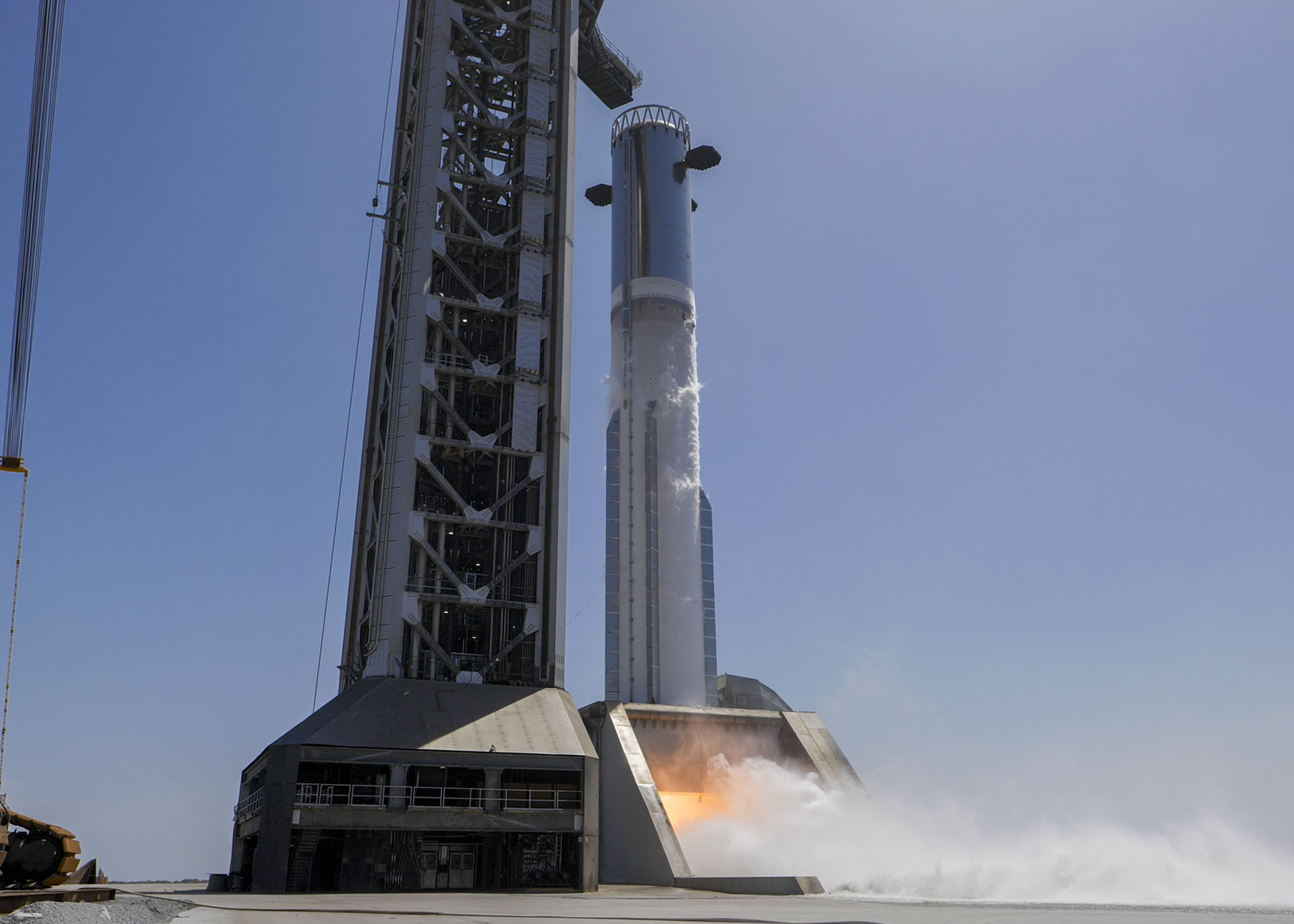
SpaceX, the space exploration and commercial spaceflight company founded by Elon Musk, recently conducted a static fire test on Starship’s Flight 12 Booster 19. The test involved firing a set of ten Raptor 3 engines on Booster 19.
Live observers noted that the static fire test was shorter than expected, as it was cut off early due to a ground-side issue. Despite this, SpaceX confirmed that the Raptor 3 engines performed well during the test, and they are now gearing up for a full-scale 33-engine static fire test in preparation for the Flight 12 launch scheduled for mid to late April.
In an official statement released by SpaceX, they mentioned the completion of initial ground testing on Flight 12 vehicles, including Booster 19 and Starship 39. The statement highlighted the successful startup of all installed Raptor 3 engines and the upcoming 33-engine static fire test.
Following the 10-engine static fire test on Booster 19, SpaceX has transported the Starship rocket back to the production site for the installation of 33 Raptor 3 engines. These engines produce a combined thrust of 9,240 tons-force and are essential for powering the massive Starship vehicle.
The Pad 2 orbital launch mount at the Starbase launch site, where the tests were conducted, underwent rigorous testing to handle the force and heat generated by the Raptor 3 engines. The flame trench and water deluge systems on Pad 2 have been rebuilt to ensure the safe and efficient operation of the launch site.
Starship 39, the upper stage of the Starship V3 vehicle, has already completed cryogenic pressure-proof tests, indicating progress towards rapid reusability. SpaceX aims to achieve rapid reusability with Starship, a crucial factor for future missions to colonize the Moon and Mars.
As SpaceX prepares for the Flight 12 launch and landing test in April, they continue to make advancements in their Starship program. Stay tuned for further updates on Starship and SpaceX as they push the boundaries of space exploration and commercial spaceflight.