
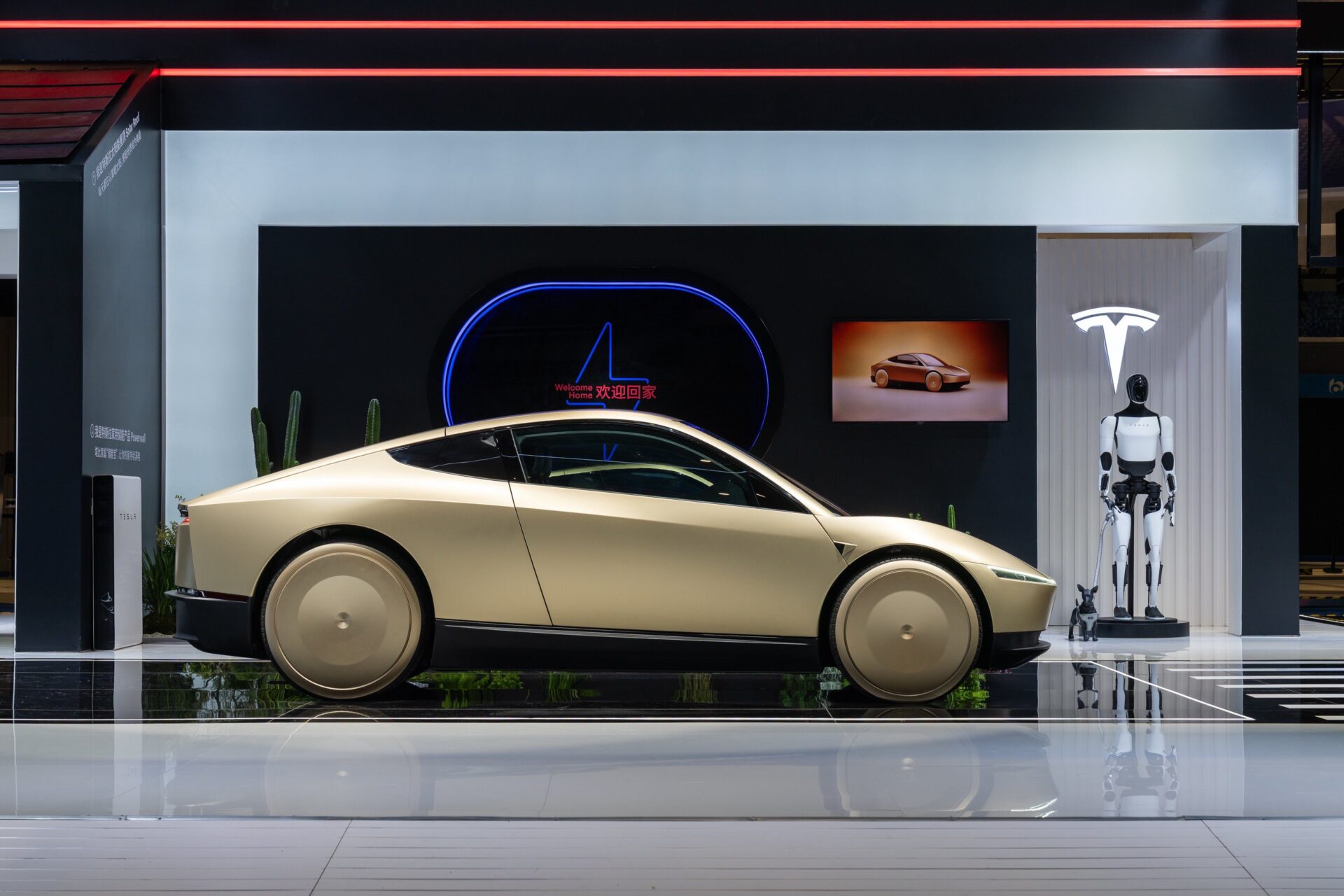
Tesla continues to push the boundaries of autonomous vehicle technology with its latest iteration of the Cybercab, spotted testing on public roads in Austin, Texas. This time, the Cybercab was seen without side mirrors, a significant departure from traditional car design. The move towards a mirror-less design showcases Tesla’s commitment to relying solely on cameras and neural networks for navigation, rather than legacy automotive hardware.
The Cybercab is a purpose-built two-seat, all-electric autonomous vehicle intended for Tesla’s Robotaxi network. Unlike current Tesla models, the Cybercab is expected to be devoid of a steering wheel, pedals, and now side mirrors. Instead, it will rely entirely on Tesla’s Full Self-Driving system to operate within the shared autonomous fleet.
Tesla has been steadily increasing its testing of the Cybercab in various locations, with sightings in California, Texas, New York, Illinois, and Massachusetts. With at least eleven Cybercabs actively undergoing testing, it appears that Tesla is entering the final validation phase before production begins. According to Tesla’s timeline, volume production of the Cybercab is set to commence in April.
The removal of side mirrors is just one step towards Tesla’s vision for a fully autonomous vehicle. The next potential hardware change could be the elimination of the steering wheel altogether, further distinguishing the Cybercab from traditional cars on the road. If this comes to fruition, the Cybercab will not only look different but also function in a fundamentally new way.
As Tesla continues to innovate in the realm of autonomous driving, the Cybercab represents a bold step towards a future where self-driving vehicles are the norm. With each new development, Tesla is bringing us closer to a world where transportation is safer, more efficient, and more sustainable.