
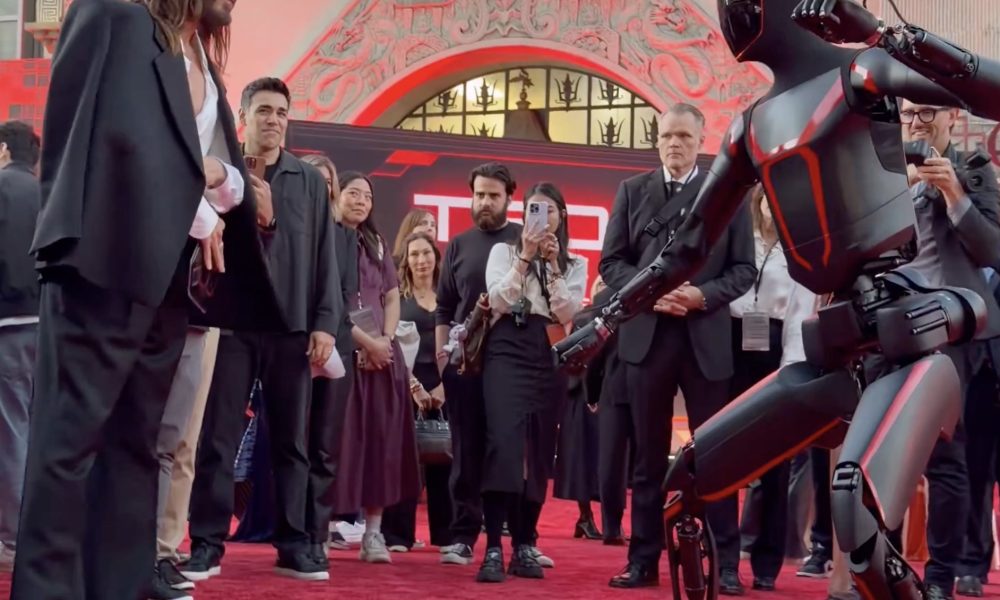
When TRON: ARES made its first public splash, the reaction wasn’t driven only by neon visuals or nostalgia for the Grid. What truly caught people off guard was how naturally the moment aligned with a real-world symbol of the future: Tesla’s Optimus humanoid robot.
The crossover didn’t feel like a gimmick. It felt inevitable.
A Sci-Fi Moment That Didn’t Stay on the Screen
TRON has always represented a future just slightly out of reach. Clean lines. Intelligent systems. Humans and machines sharing space in ways that feel both exhilarating and unsettling.
Optimus brought that idea off the screen and into the room.
As footage, references, and discussions around Optimus circulated alongside the debut of TRON: ARES, audiences weren’t just watching a movie announcement. They were seeing a live example of the kind of world the TRON universe has promised for decades. A humanoid machine designed not as a fantasy weapon or villain, but as a worker, assistant, and presence.
That contrast mattered.
Why Optimus Fit the Moment Perfectly
Optimus didn’t need to perform theatrics to command attention. Its design language already speaks the same visual dialect as TRON: minimalist, purposeful, and quietly confident. No exposed gears. No exaggerated aggression. Just form following function.
What captivated people wasn’t what Optimus did, but what it suggested.
A future where advanced machines are not confined to digital worlds or cinematic universes. A future where they stand beside us, operating in physical space, solving real problems.
TRON imagined that future.
Optimus hints that it’s arriving.
Culture Is Catching Up to Technology
For years, science fiction raced ahead of reality. Movies promised futures that engineering couldn’t yet deliver. That gap is closing.
The audience reaction around the TRON: ARES debut showed a shift. Viewers weren’t asking whether humanoid robots were possible. They were asking when, how, and where they would fit into daily life.
Optimus reframed the conversation. Instead of being a prop from a fictional universe, it became a reference point. Something tangible. Something already in development.
That shift in mindset is subtle but profound.
The Symbolism Matters More Than the Demo
Optimus didn’t need to steal the stage. Its presence alone was enough to anchor the moment. In a franchise built on the idea of digital beings crossing into the human world, a real humanoid robot standing in the cultural spotlight carried weight.
It signaled that we’re entering a phase where technology doesn’t need dramatic reveals to feel disruptive. Simply existing is enough.
The audience reaction reflected that. Less shock. More curiosity. Less disbelief. More expectation.
From Fiction to Familiar
What made the moment resonate is that Optimus didn’t feel alien. It felt… plausible. Familiar, even.
That’s the real takeaway from the overlap between Tesla Optimus and TRON: ARES. Not that a robot appeared near a movie moment, but that audiences are increasingly comfortable with the idea that the future promised by science fiction is no longer abstract.
It’s being assembled, iteration by iteration, in the real world.
And when a humanoid robot can stand in the same cultural conversation as one of sci-fi’s most iconic franchises without feeling out of place, that tells you something important.
The Grid isn’t coming someday.
It’s already bleeding into reality.