
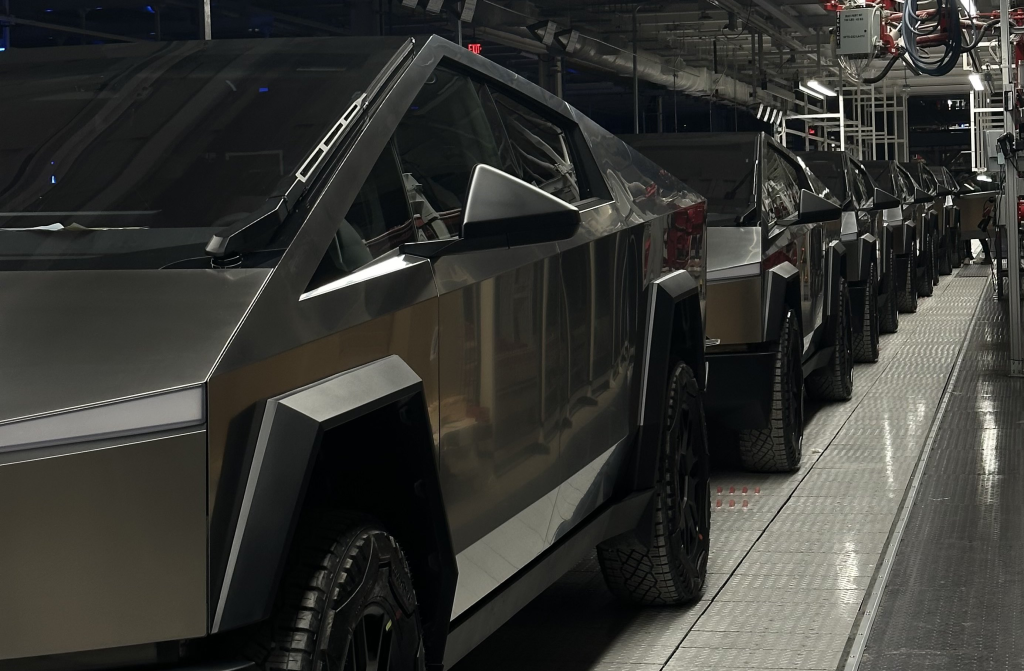
Tesla may be rethinking the Cybertruck’s role after investor questions about a more conventional pickup prompted Elon Musk to propose an autonomous cargo delivery future. After the unveiling of the Cybertruck in 2019, Musk later mentioned the possibility of a redesign to make it more in line with traditional pickup trucks.
However, instead of just redesigning the Cybertruck, Musk has introduced a whole new vision for its future. He envisions a world where autonomous Cybertrucks serve as delivery vehicles, transporting goods from warehouses to customers without the need for human drivers.
This autonomous delivery vision aligns with Tesla’s broader goal of revolutionizing the transportation industry with electric and self-driving vehicles. By repurposing the Cybertruck for cargo delivery, Tesla could potentially tap into a lucrative market for autonomous logistics.
The idea of using the Cybertruck for autonomous delivery is not far-fetched. Tesla has already made significant progress in developing autonomous driving technology through its Full Self-Driving (FSD) system. With improvements in artificial intelligence and sensor technology, Tesla’s vehicles are becoming increasingly capable of navigating complex urban environments without human intervention.
In addition to the technological advancements, Tesla’s vast network of Supercharger stations could support the operation of autonomous delivery vehicles. These charging stations provide a convenient and reliable way for electric vehicles to recharge, ensuring that the Cybertrucks can operate efficiently and without interruption.
Furthermore, Tesla’s experience in mass-producing electric vehicles could give them a competitive edge in the autonomous delivery market. The company’s Gigafactories are capable of producing vehicles at scale, allowing Tesla to quickly deploy fleets of autonomous Cybertrucks for delivery services.
Overall, Tesla’s decision to explore the possibility of using the Cybertruck for autonomous delivery reflects the company’s innovative approach to transportation and logistics. By leveraging its expertise in electric vehicles, autonomous driving technology, and manufacturing, Tesla could revolutionize the way goods are transported and delivered in the future. The world of technology is constantly evolving, with new advancements being made on a daily basis. One of the most exciting developments in recent years is the rise of artificial intelligence (AI) and machine learning. These technologies are revolutionizing the way we interact with machines and are opening up new possibilities in a wide range of industries.
Artificial intelligence refers to the ability of machines to perform tasks that typically require human intelligence, such as visual perception, speech recognition, decision-making, and language translation. Machine learning is a subset of AI that involves the use of algorithms to enable machines to learn from data and make decisions without being explicitly programmed.
One of the most significant applications of AI and machine learning is in the field of healthcare. These technologies are being used to analyze medical images, predict patient outcomes, and even assist in the development of new drugs. For example, AI algorithms can analyze X-rays and MRI scans to detect abnormalities and help doctors make more accurate diagnoses. In addition, machine learning models can be trained on massive amounts of data to predict the likelihood of a patient developing a certain disease or condition.
In the field of finance, AI and machine learning are being used to improve fraud detection, automate trading strategies, and personalize customer experiences. Banks and financial institutions are using AI algorithms to analyze patterns in customer behavior and detect fraudulent transactions in real-time. Machine learning models are also being used to predict stock market trends and optimize investment portfolios.
In the retail industry, AI and machine learning are being used to enhance the customer shopping experience and improve operational efficiency. Retailers are using AI-powered chatbots to provide personalized recommendations to customers and assist with customer service inquiries. Machine learning algorithms are also being used to forecast demand for products, optimize pricing strategies, and streamline inventory management.
In the field of transportation, AI and machine learning are being used to improve the safety and efficiency of vehicles. Self-driving cars rely on AI algorithms to navigate roads, detect obstacles, and make split-second decisions to avoid accidents. Machine learning models are also being used to optimize traffic flow, reduce congestion, and improve fuel efficiency in public transportation systems.
Overall, the possibilities for AI and machine learning are endless. These technologies have the potential to revolutionize every industry and transform the way we live and work. As researchers continue to make advancements in this field, we can expect to see even more exciting applications of AI and machine learning in the years to come.