
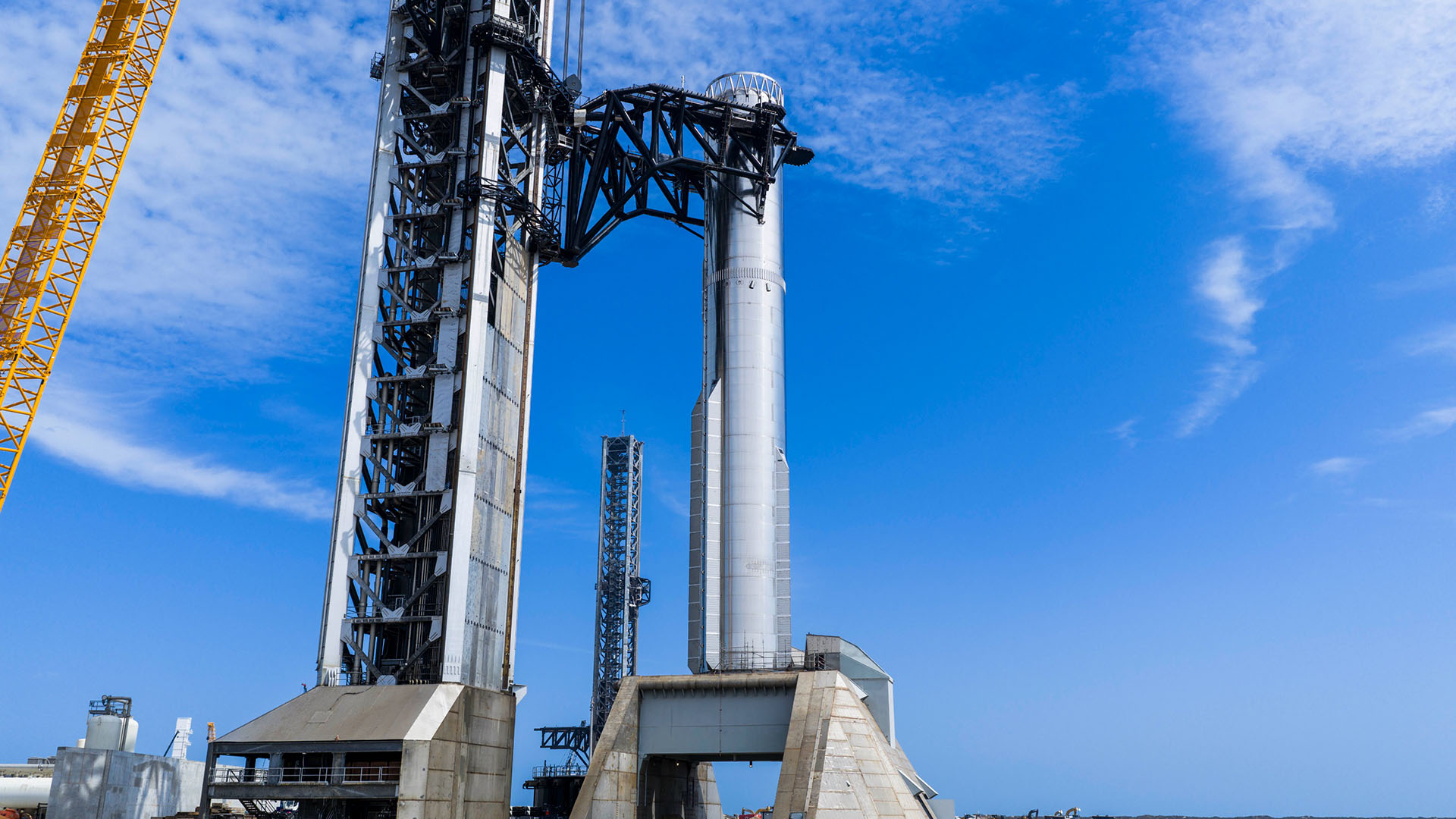
Earlier this morning, SpaceX shared an update on the development progress and further plans in preparation for the Flight 12 Starship launch. The current generation Starship V3 consists of three major components: the 1st/lower stage Super Heavy Booster V3, the 2nd/upper stage Starship V3 spacecraft, and the Raptor 3 engines.
Booster 19 and Ship 39 have been assigned as the first V3 prototypes for the Flight 12 launch and landing test (IFT-12). This upcoming launch will mark the first test with a V3 Starship generation, also known as the Block 3 Starship. The Raptor 3 engines, which will power this new generation Starship, are set to be tested on a flight-intent vehicle for the first time.
SpaceX recently moved Booster 19 out of the High Bay at the production site and mounted it on Pad 2 at the SpaceX Starbase in Texas. Pad 2 has been specially designed to support Starship V3 launches and features an updated water deluge system to manage the heat and fire generated by the 33 Raptor 3 engines during liftoff.
Booster 19 has already completed cryogenic pressure-proof tests, and SpaceX is gearing up for the most epic static fire test. This test will involve igniting the rocket engines while the vehicle is held in place on the launch mount.
In the coming days, SpaceX plans to conduct a series of tests to activate Pad 2, test new propellant loading operations, and operate a vehicle with the new Raptor 3 engines installed for the first time. The road to the Flight 12 launch promises to be exciting, with SpaceX eyeing April as the potential launch window.
For more updates on Starship and SpaceX, follow us on Google News, X (Twitter), Flipboard, WhatsApp Channel, and RSS (Feedly). Stay tuned for the latest developments in the world of space exploration.
[Related: Starship Flight 12: SpaceX to test Raptor 3 engines on the V3 Booster 19 for the first time] On the 8th of March 2026, SpaceX made history once again by conducting the 12th test flight of its Starship spacecraft. This particular test involved the testing of the new Raptor 3 engines on the V3 Booster 19 for the very first time. The test was a crucial step in the development of SpaceX’s next-generation spacecraft, which is designed to take humans to Mars and beyond.
The test flight took place at the company’s testing facility in Texas, where the Starship V3 (Ship 39) had undergone three successful cryogenic pressure-proof tests in the weeks leading up to the flight. The V3 Starship, which is the first of its kind, was escorted to the testing site by a squad of Tesla Cybertrucks, adding to the futuristic and innovative nature of the event.
The Super Heavy Booster 19, which is the prototype for the V3 Booster, had also successfully survived a cryogenic test prior to the flight. The booster was mounted on a thrust simulator stand at the testing facility, where it underwent rigorous pre-launch testing to ensure its readiness for the test flight.
The success of the test flight marked a significant milestone for SpaceX, as it demonstrated the viability of the new Raptor 3 engines and the V3 Booster design. The company has been working tirelessly to develop the next generation of spacecraft that will enable humans to explore the cosmos in ways never before possible.
In addition to the test flight, SpaceX also made headlines recently for its acquisition of xAI, a company specializing in building AI data centers in space. The acquisition, along with a $2 billion investment from Tesla (TSLA), is part of SpaceX’s broader strategy to expand its capabilities in space technology and exploration.
Looking ahead, SpaceX has ambitious plans to produce around 10,000 Starships per year at its Starbase facility in Texas. This massive production capacity will enable the company to accelerate its space exploration efforts and pave the way for a future where humans can travel to other planets with ease.
Overall, the recent developments at SpaceX demonstrate the company’s commitment to pushing the boundaries of space exploration and technology. With each successful test flight and innovation, SpaceX is bringing humanity one step closer to realizing the dream of becoming a multi-planetary species.