
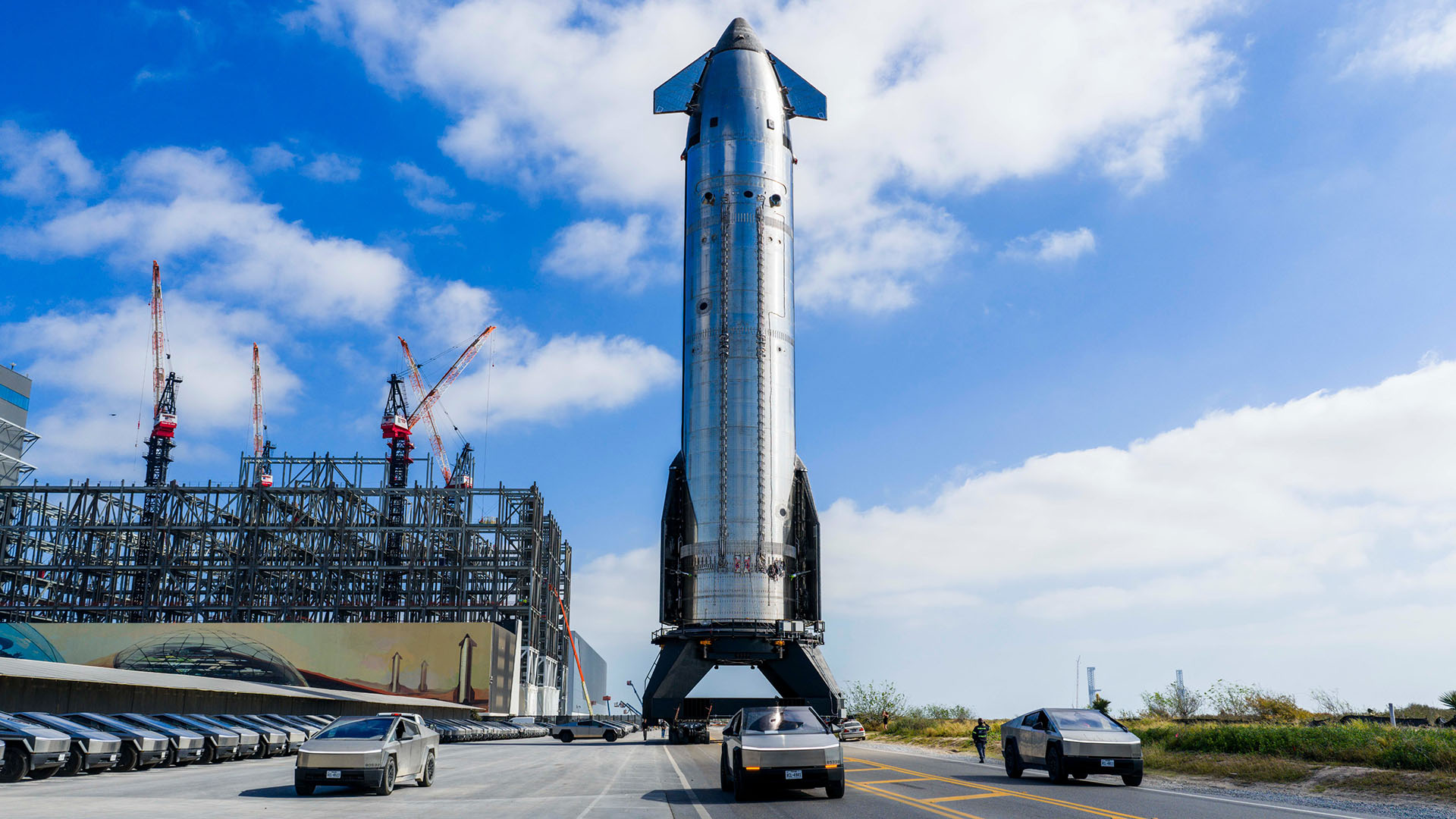
Yesterday, Elon Musk’s space exploration and astronautics company SpaceX made a significant move by transporting its next-generation first Starship V3 (Ship 39) from the production site to Massey’s Outpost at the Starbase launch site. The purpose of this move was to conduct prelaunch testing on the Flight 12-intent Starship prototype, which includes cryogenic pressure-proofing and static fire tests.
As of now, approximately 24 hours after the Starship’s relocation to Massey’s Outpost, SpaceX has not yet commenced the testing procedures. These tests are crucial steps towards the 12th flight test of the Starship.
Notably, this launch and landing test will be different in several ways as SpaceX is testing the V3 Starship for the first time. The previous generation, known as Flight 11, was the last time the Starship V2 launch and landing were observed.
SpaceX shared striking imagery of Starship 39 being moved to Massey’s on the transport stand, accompanied by a three-member Cybertruck squad. The Cybertruck fleet, acquired by SpaceX last year, aids in Starbase operations and inventory clearance for Tesla.
The Starship V3 (Ship 39) is larger than its predecessor, with dimensions that make the Tesla Cybertruck appear small in comparison. The first V3 prototype was seen parked in the Starbase Megabay hangar before its journey to the Massey’s test site, showcasing a belly side covered in black heat shield tiles, a vital component of the thermal protection system.
During the Flight 11 test, SpaceX intentionally left some areas without heat protection tiles to study the spacecraft’s performance in extreme temperatures. However, for the upcoming Flight 12 test, SpaceX plans to keep all tiles intact and evaluate the Starship V3’s handling of heat during atmospheric entry and landing.
FAA approval for the Flight 12 Starship launch and landing test has been granted. However, the specific date for Flight 12 remains undisclosed as the upper stage Ship 39 undergoes further testing.
Starbase Updates (Flight 12 Preparations)
Significant developments have transpired at Starbase, Texas since the last Booster 19 test report earlier this month. SpaceX has been actively developing and testing systems necessary for the Flight 12 Starship launch test. Water deluge tests on Pad 2 and the flame trench have been conducted to neutralize heat and flames generated during liftoff by 33 Raptor engines.
SpaceX has redesigned and re-engineered Pad 2 to accommodate V3 Starship prototypes, underscoring the importance of the water deluge system in preventing heat or fire-related damage. Additionally, the water deluge system has been upgraded to remove oxygen beneath the pad, further enhancing fire mitigation efforts.
Pad 1, originally designed for the previous generation Starship V2, is being reconstructed to accommodate Starship V3 Super Heavy rocket boosters. SpaceX is diligently preparing the launch site and pad for the upcoming tests.
SpaceX Shifts Focus from Mars to the Moon
In a recent post on X, Elon Musk announced SpaceX’s shift in focus from Mars to establishing a base on the Moon before embarking on the Mars mission. This strategic change aims to expedite the establishment of an intermediary human base on the Moon before venturing to Mars.
Starship serves as the primary spacecraft for SpaceX’s future missions to the Moon and Mars, despite being in the testing phase. The company’s efforts are now concentrated on Moon exploration, with Mars missions slated for the future.
SpaceX is making significant strides in its mission to extend consciousness and life to the stars. The company has shifted its focus to building a self-growing city on the Moon, a project that could be completed in less than 10 years. In comparison, building a city on Mars would take more than 20 years. The ultimate goal of SpaceX is to secure the future of civilization by establishing colonies on other celestial bodies.
One of the reasons why SpaceX is prioritizing the Moon over Mars is the frequency of launch opportunities. While it is only possible to travel to Mars when the planets align every 26 months, launches to the Moon can occur every 10 days. This means that SpaceX can iterate much faster and complete a Moon city in a shorter amount of time compared to a Mars city.
Although SpaceX plans to begin building a Mars city within the next 5 to 7 years, the primary focus at the moment is on the Moon. The company believes that establishing a presence on the Moon is a more achievable goal in the near future. By creating a self-sustaining city on the Moon, SpaceX aims to lay the groundwork for future missions to Mars and beyond.
As SpaceX continues to develop its Starship spacecraft, the potential for space travel and colonization is becoming increasingly realistic. Stay tuned for more updates on SpaceX and the Starship project, as the company works towards making humanity a multi-planetary species. The COVID-19 pandemic has had a significant impact on every aspect of our lives, from our health and well-being to our economy and daily routines. As we continue to navigate through these challenging times, it is important to stay informed about the latest developments and guidelines to ensure the safety of ourselves and our loved ones.
One of the most crucial aspects of managing the pandemic has been the implementation of vaccination campaigns. Vaccines have been developed at an unprecedented pace and have played a key role in controlling the spread of the virus and reducing the severity of illness in those who do become infected. As more and more people around the world receive their vaccinations, there is hope that we can eventually bring an end to the pandemic.
However, the rollout of vaccination campaigns has not been without its challenges. In some regions, there have been logistical issues in distributing the vaccines, leading to delays in getting people vaccinated. There has also been hesitancy among some individuals about receiving the vaccine, either due to misinformation or concerns about its safety and efficacy. It is important for health authorities and governments to address these concerns and continue to educate the public about the importance of getting vaccinated to achieve herd immunity.
In addition to vaccination, it is crucial for everyone to continue following public health guidelines to prevent the spread of the virus. This includes wearing masks, practicing social distancing, washing hands regularly, and avoiding large gatherings. These measures have been proven to be effective in reducing transmission of the virus and protecting vulnerable populations.
As we move forward in the fight against COVID-19, it is important for us to remain vigilant and continue to support one another. The pandemic has taken a toll on our physical and mental health, and it is crucial for us to take care of ourselves and each other during these difficult times. By working together and following the guidance of public health experts, we can overcome this crisis and emerge stronger and more resilient than ever before.