
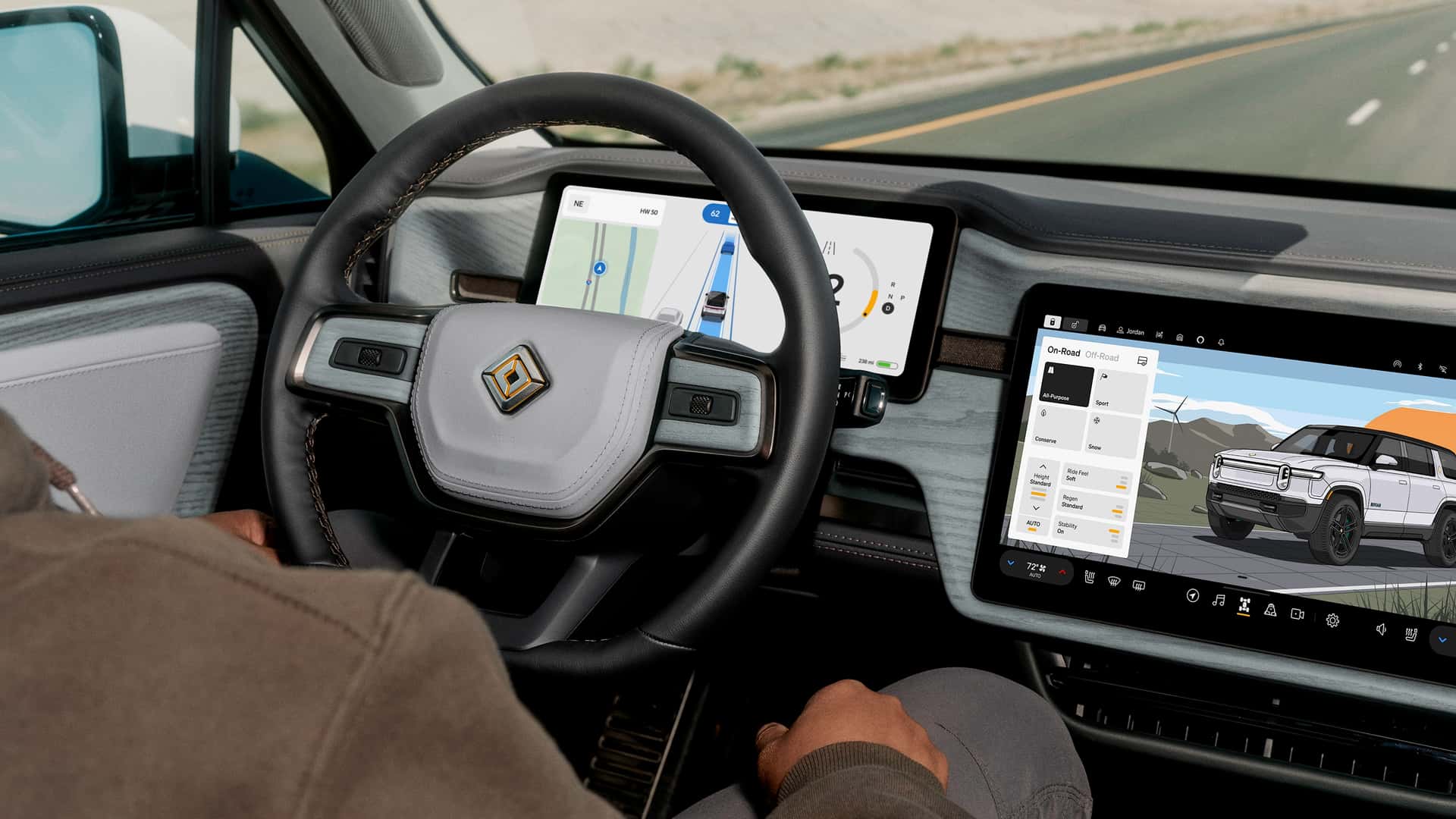
“Hands-free driving is not only a convenience but also a safety feature that can help reduce driver fatigue and improve overall road safety,” Philbin added.
The new AI-powered driving system and hands-free features being rolled out by Rivian are a significant step towards achieving Level 4 autonomous driving capabilities. The company’s Autonomy+ subscription, set to launch in 2026, will provide users with access to these advanced features for a one-time fee of $2,500 or a monthly subscription of $49.99.
One of the standout features of Rivian’s new AI system is the integration of a voice assistant that can sync with Google Calendar. This will not only enhance the user experience but also improve the company’s service and diagnostics processes.
The upcoming second-generation Rivian R1 vehicles and the highly anticipated R2 crossover will be the first to receive these updates. The R2 will also be the most affordable new car in the U.S. market to deploy lidar technology for advanced autonomous driving assistance features.
The Rivian Autonomy Platform represents a significant investment by the California-based electric vehicle startup in developing AI-powered systems for training cars to operate autonomously. While Level 4 autonomy is not yet available on consumer-owned cars, Rivian has a clear trajectory towards achieving this goal.
The Universal Hands-Free (UHF) driving system, part of the Rivian Autonomy Platform, will enable hands-off assisted driving on almost any road with clearly painted lines. This feature will be available on approximately 3.5 million miles of roads in the U.S. and Canada, allowing the vehicle to follow lane markings and maintain distance from other cars.
The Autonomy+ subscription will unlock the Universal Hands-Free feature for Rivian owners, offering a seamless driving experience on a wide range of roads. Despite the subscription model, the popularity of hands-free driving features among consumers indicates a willingness to pay for added convenience and safety.
Overall, Rivian’s focus on AI-powered driving systems and hands-free capabilities represents a significant step towards achieving fully autonomous driving in the future. With the launch of the Autonomy+ subscription and the integration of advanced features in upcoming models, Rivian is positioning itself as a leader in the electric vehicle market. Rivian is making waves in the automotive industry with its latest advancements in AI technology. The company’s Autonomy Platform is a game-changer, utilizing an AI model inspired by Large Language Models like OpenAI’s GPT-4/4o and Google’s Gemini. This model continuously learns from real-world driving experiences, such as near-collisions and challenging intersections, to enhance its performance. By collecting data from Rivian drivers worldwide, the platform improves over time, providing a safer and more efficient driving experience.
While Rivian’s Autonomy Platform is not as advanced as Tesla’s Full Self-Driving system, it still offers impressive capabilities. With the inclusion of radar sensors, Rivian’s EVs can handle various driving scenarios with ease. However, drivers are still required to intervene in certain situations, such as using the brake pedal at stoplights. Nevertheless, continuous training and updates are expected to enhance the platform’s functionality over time.
In addition to its Autonomy Platform, Rivian is introducing a cutting-edge AI voice assistant called Rivian Assistant. This conversational AI will debut on both Gen 1 and Gen 2 R1 vehicles early next year, providing users with a natural and intuitive interface. The Rivian Assistant leverages multiple Large Language Models to answer queries and control vehicle functions seamlessly. From adjusting seat heaters to scheduling events on Google Calendar, this AI assistant simplifies the driving experience and integrates with external apps for added convenience.
While Rivian is not the only automaker exploring AI-driven features, its innovative approach sets it apart in the industry. With competitors like Mercedes-Benz and Tesla also investing in advanced voice AI technologies, the race to deliver intelligent and user-friendly features is heating up. As Rivian continues to refine its Autonomy Platform and Rivian Assistant, it aims to demonstrate the safety and practicality of urban automated driving. By prioritizing user experience and innovation, Rivian is paving the way for a future where AI-powered features enhance the driving experience for all. It’s no secret that the world of technology is constantly evolving. New innovations and advancements seem to be announced almost daily, and it can be hard to keep up with the latest trends. One area that has seen significant growth in recent years is artificial intelligence (AI).
AI is the simulation of human intelligence processes by machines, especially computer systems. This technology has the ability to learn, reason, and adapt to new situations, making it a powerful tool in a variety of industries. From self-driving cars to virtual assistants like Siri and Alexa, AI is becoming increasingly integrated into our everyday lives.
One of the most exciting developments in AI is its potential to revolutionize the healthcare industry. AI has the ability to analyze vast amounts of data quickly and accurately, which can lead to more accurate diagnoses and better treatment options for patients. For example, AI can be used to analyze medical images like X-rays and MRIs, allowing doctors to detect diseases and conditions earlier than ever before.
In addition to improving patient care, AI is also being used to streamline administrative tasks in healthcare settings. By automating tasks like scheduling appointments and processing insurance claims, AI can free up healthcare professionals to focus on providing quality care to their patients.
But AI isn’t just benefiting the healthcare industry. It’s also being used in a variety of other sectors, including finance, manufacturing, and retail. In finance, AI is being used to detect fraudulent activity and predict market trends. In manufacturing, AI is being used to optimize production processes and improve efficiency. And in retail, AI is being used to personalize shopping experiences and improve customer service.
Despite its many benefits, AI does raise some concerns. There are worries about job displacement as AI becomes more integrated into various industries. There are also ethical concerns about the use of AI, particularly when it comes to issues like privacy and bias.
Overall, AI is a powerful technology that has the potential to change the way we live and work. As it continues to evolve, it will be important for policymakers, businesses, and individuals to work together to ensure that AI is used in a responsible and ethical manner. With the right approach, AI has the potential to improve our lives in ways we never thought possible.