
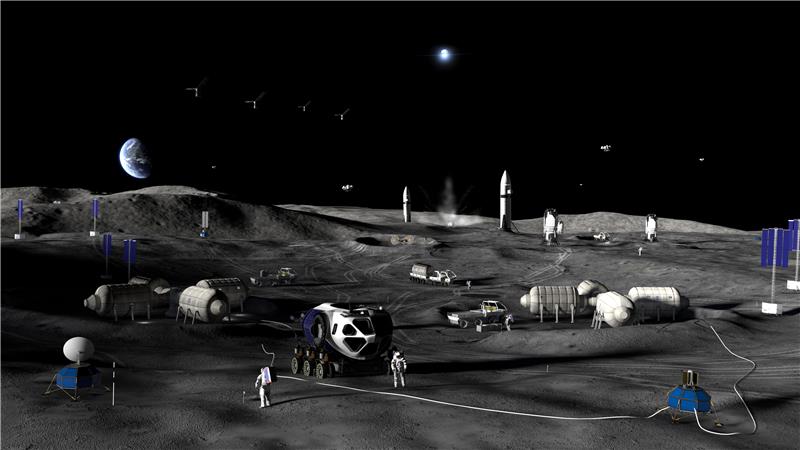
NASA’s Ambitious Plan to Build Moon Base and Launch Nuclear-Powered Spacecraft to Mars by 2028
In a groundbreaking announcement, NASA revealed its bold new strategy to establish a permanent Moon base and send a nuclear-powered spacecraft to Mars by 2028. The agency is streamlining its processes to meet the ambitious goal of returning humans to the lunar surface within the current presidential term.
NASA Administrator Jared Isaacman emphasized the urgency of the mission, stating that success will now be measured in months, not years. To achieve this objective, NASA plans to conduct annual landing missions on the Moon starting in 2027, with a goal of increasing the frequency to every six months by 2028 to sustain the operations of the new Moon base.
The construction of the Moon base will be executed in three phases. Initially, NASA will deploy robotic rovers and tools to the surface to test power generation and mobility capabilities. Subsequently, early shelters will be built to accommodate astronauts for short stays. Finally, heavy-lift landing systems will be utilized to deliver large permanent habitats, transforming the Moon into a sustainable home for American explorers.
In a significant development, NASA is venturing into nuclear power by launching Space Reactor-1 Freedom, the first nuclear-powered spacecraft designed for deep space exploration, towards Mars in 2028. This cutting-edge technology enables spacecraft to carry heavier payloads and travel to regions of the solar system where solar panels are ineffective. Upon reaching Mars, the spacecraft will deploy a fleet of “Skyfall” helicopters to explore the Red Planet from the air.
On a more immediate front, NASA is reimagining its approach to the International Space Station (ISS). Recognizing that the station has a limited lifespan, the agency intends to attach a government-owned core module to the ISS, paving the way for private companies to add their own modules. These private modules will eventually detach to form independent commercial space stations, ensuring continuous American presence in orbit.
To facilitate these ambitious projects, NASA is ramping up its workforce by hiring thousands of new employees and embedding experts directly into manufacturing facilities. This strategy aims to address technical challenges promptly and expedite production processes.
The future of space exploration is taking shape, with NASA’s groundbreaking initiatives setting the stage for unprecedented achievements in space travel and colonization. As the agency races against time to realize its vision of a Moon base and nuclear-powered Mars mission, the possibilities for human exploration of the cosmos are limitless.