
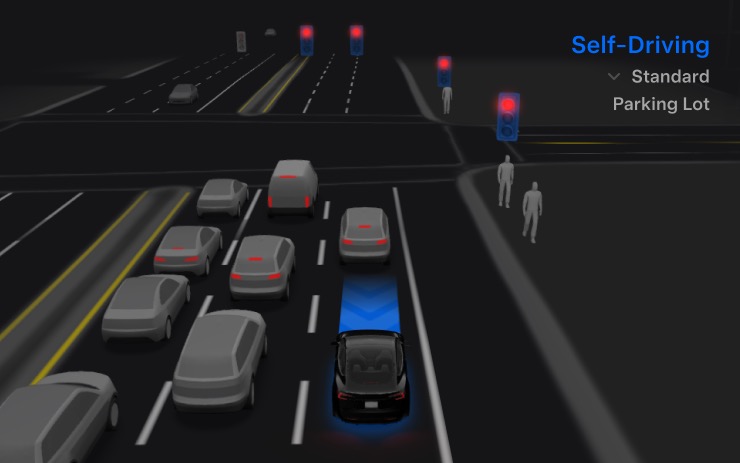
Tesla has recently released software update 2025.45.9, introducing Full Self-Driving (Supervised) v14.2.2.4 and various new driving, navigation, and convenience features. This update comes just 8 days after the previous version, showcasing the relentless efforts of the Tesla AI team in pushing out software updates.
The latest version of FSD focuses on improving how Tesla’s system perceives and reacts to the road. The updated vision system now handles emergency vehicles, road debris, obstacles, and hand signals from traffic directors more effectively. Additionally, FSD can now pull over or yield for police cars, fire trucks, and ambulances, enhancing safety on the road. Navigation has also been integrated more closely with the vision system, allowing the car to respond to blocked roads and detours in real-time.
Furthermore, Tesla has enhanced handling in challenging situations such as unprotected turns, lane changes, vehicle cut-ins, school buses, gates, and debris on the road. The update also improves the system’s error recovery capabilities, increasing overall reliability.
New arrival options have been introduced, giving drivers the ability to choose where FSD should stop or park when arriving at a destination. Options include parking lots, streets, driveways, parking garages, or curbside drop-offs, with preferences being saved for specific locations.
Tesla has also added new driving style options for FSD, replacing the previous precise mph/kph offset with more intuitive personalities. The new Sloth mode prioritizes lower speeds and cautious lane choices, sticking strictly to the speed limit, while the Mad Max mode allows for higher speeds and more assertive driving behavior. Driver profiles now play a significant role in determining how assertive the system behaves.
Interface and controls updates include the ability to view self-driving stats in the vehicle settings, start FSD directly from the touchscreen while parked or driving, and adjust speed profiles and arrival options from the driving display. By default, FSD no longer requires a brake press to confirm activation, although this feature can be toggled in the settings.
Other notable features in the update include voice-based navigation changes using Tesla’s Grok assistant, a new in-car Photobooth feature, Live Activity support for Dog Mode on iPhone, more detailed dashcam playback information, navigation upgrades such as HOV lane routing and Supercharger site maps, new Light Show and Santa Mode updates, and a SpaceX docking simulator game.
It is important to note that Tesla emphasizes that Full Self-Driving (Supervised) still requires active driver attention and does not make the vehicle autonomous. With these new features and updates, Tesla continues to improve the driving experience for its customers.