
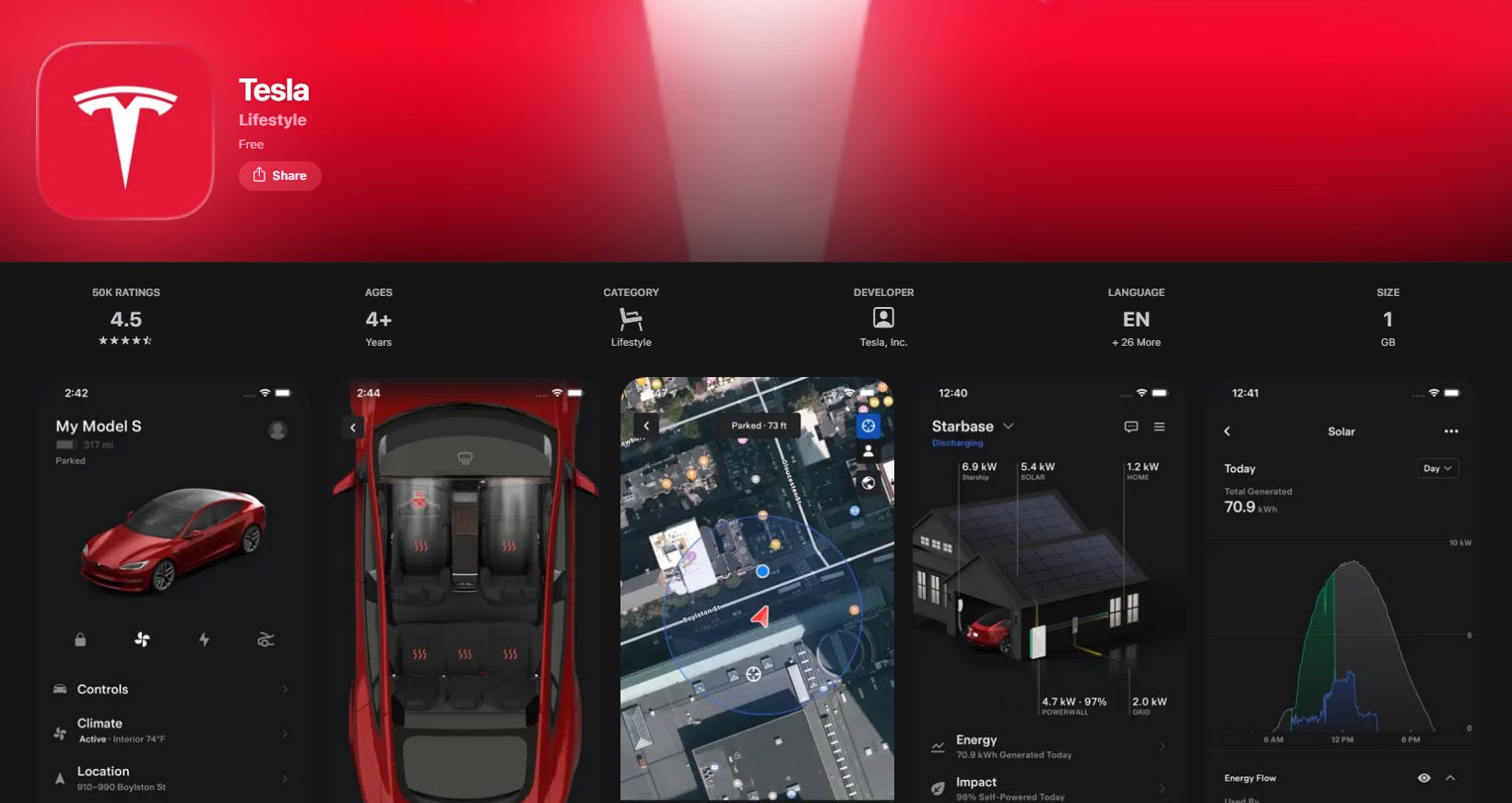
Tesla has recently released an update to its iOS app, version 4.51.5, which brings a new feature that enhances the user experience. The update includes a new real-time directional view on the app’s homepage, similar to Apple’s Precision Finding in the Find My app. This feature allows users to easily locate their parked Tesla by providing a directional arrow that points towards the vehicle and displays the precise distance in real time as the user moves.
The introduction of this feature is a significant improvement in terms of convenience, especially in crowded parking lots or unfamiliar locations where finding your car can be challenging. Tesla has been focusing on enhancing the utility of its smartphone app, and this latest update is a testament to their commitment to providing a seamless user experience.
Furthermore, the update is believed to be preparing the app for Tesla’s upcoming 2025 Holiday Update, which was unveiled recently and is expected to introduce a variety of new features. These include festive UI elements, the ability to interact with Grok for navigation stops, a Toybox feature that turns the Tesla into a photobooth, an enhanced media experience, support for custom wraps for the vehicle icon, and more. The latest app update lays the groundwork for these upcoming features, including improved dashcam handling.
In addition to the directional view feature, users have also noticed a new Dashcam Viewer button on the app’s homepage, making it easier for users to access and review live dashcam footage. This update aligns with Tesla’s strategy of turning its mobile app into a comprehensive command center for both drivers and energy customers.
This latest release follows a previous major app update that introduced live weather data for Powerwall owners. Together, these updates demonstrate Tesla’s ongoing efforts to enhance the functionality and usability of its mobile app, providing users with a more seamless and integrated experience. Tesla continues to innovate and improve its technology to meet the needs of its customers and enhance the overall driving experience. The world of technology is constantly evolving, with new innovations and advancements being made every day. One such area that has seen significant progress in recent years is artificial intelligence (AI). AI is a branch of computer science that aims to create machines that can perform tasks that typically require human intelligence, such as visual perception, speech recognition, decision-making, and language translation.
One of the most exciting developments in AI is the creation of neural networks. Neural networks are a type of AI that is inspired by the structure of the human brain. They consist of layers of interconnected nodes, or artificial neurons, that work together to process information and perform tasks. Neural networks are capable of learning from data, which allows them to improve their performance over time.
Another area of AI that has seen rapid advancement is natural language processing (NLP). NLP is a branch of AI that focuses on enabling machines to understand and generate human language. This technology is used in applications such as virtual assistants, chatbots, and language translation services. With the help of NLP, machines can analyze and interpret text, speech, and even emotions, allowing for more natural and intuitive interactions between humans and computers.
AI is also being used in healthcare to improve patient outcomes and streamline medical processes. Machine learning algorithms can analyze vast amounts of medical data to identify patterns and trends that can help physicians make more accurate diagnoses and treatment decisions. AI-powered medical imaging tools can also assist radiologists in detecting and diagnosing diseases such as cancer at an earlier stage.
In the field of autonomous vehicles, AI is playing a crucial role in enabling self-driving cars to navigate and respond to their environment. Machine learning algorithms are used to analyze sensor data, such as radar and lidar, to detect objects and obstacles on the road. AI-powered systems can also predict and react to traffic conditions, weather changes, and other variables to ensure a safe and efficient driving experience.
While the advancements in AI are certainly impressive, there are also ethical considerations that must be taken into account. As AI becomes more integrated into society, questions about privacy, bias, and accountability arise. It is essential for developers and policymakers to address these concerns and ensure that AI technologies are used responsibly and ethically.
Overall, AI has the potential to revolutionize industries and improve our daily lives in countless ways. From healthcare to transportation to communication, AI is reshaping the way we interact with technology and the world around us. As researchers continue to push the boundaries of AI, we can expect even more exciting advancements in the years to come.