
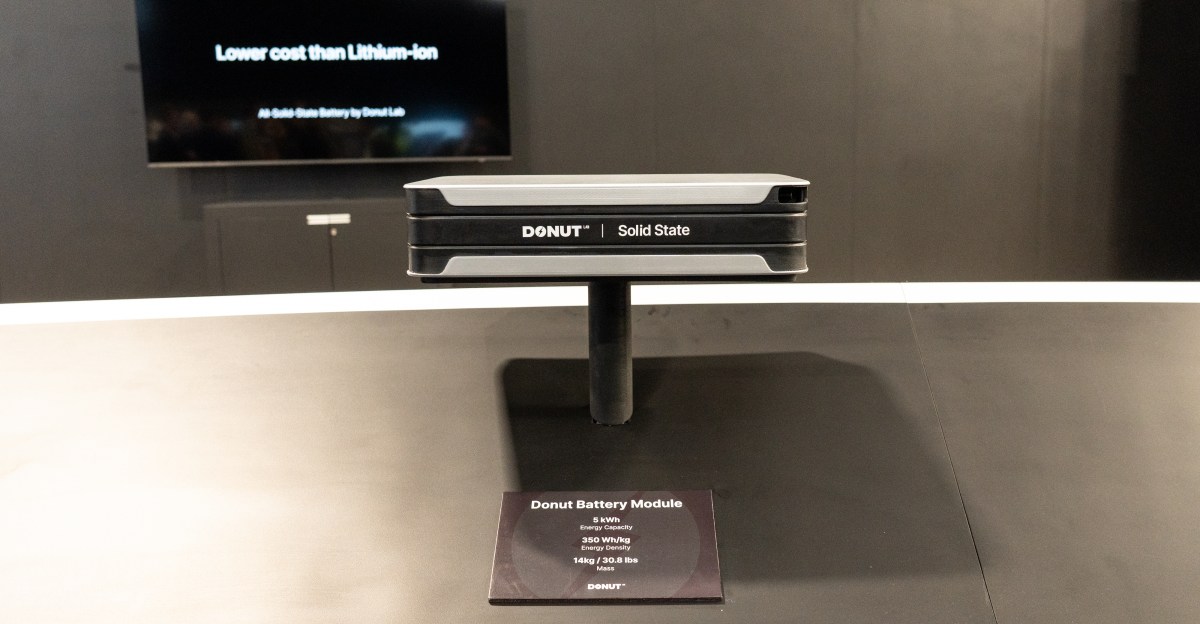
A recent study conducted by the state-owned VTT Technical Research Centre of Finland has shed light on the impressive capabilities of Donut Lab’s solid-state battery technology. The team set out to test the battery’s performance under extreme heat conditions, a factor known to negatively impact traditional lithium-ion batteries.
The results of the study were quite remarkable. The solid-state battery was able to discharge energy even at temperatures as high as 100 degrees Celsius (212 degrees Fahrenheit), and what’s more, it actually showed an increase in capacity under these extreme conditions. This is a significant finding as it demonstrates the potential of Donut Lab’s technology to outperform conventional lithium-ion batteries in terms of resilience and efficiency.
The test involved subjecting a 3.6V/26 Amp-hour solid-state battery to three different temperature settings: a baseline test at room temperature (20C), a high-heat test at 80C, and an extreme-heat test at 100C. The battery was placed under physical pressure using a steel plate and housed in a temperature-controlled chamber to simulate real-world conditions.
Surprisingly, the battery’s performance improved as the temperature increased. At room temperature, the battery delivered 24.9Ah, which served as the benchmark for comparison. At 80C, it delivered 27.5Ah, representing a 10.5% increase in capacity, and at 100C, it delivered 27.6Ah, showing a 7.1% increase compared to its performance at room temperature. Although the battery experienced some physical damage due to the extreme heat, it was still functional and rechargeable.
Solid-state batteries have long been hailed as the “holy grail” of battery technology due to their potential for higher energy density, faster charging times, and improved safety compared to traditional liquid electrolyte batteries. Donut Lab’s solid-state battery, made of dry conductive materials, offers a promising solution to the limitations of current battery technology.
One of the key advantages of solid-state batteries is their enhanced tolerance to extreme temperatures. By replacing flammable liquid electrolytes with solid ceramic or polymer materials, Donut Lab’s battery can maintain efficiency even at high temperatures. The study conducted by VTT revealed that the internal resistance of the solid electrolyte decreased at higher temperatures, allowing for smoother ion movement and increased capacity.
While the results of the study are promising, there are still some unanswered questions regarding Donut Lab’s solid-state battery technology. The chemistry of the battery pack has not been confirmed, and potential issues such as dendrite formation, which can cause electrical shorts, have not been addressed. Donut Lab has promised further independent testing as part of its “I Donut Believe” series to address these concerns.
Overall, the study highlights the potential of Donut Lab’s solid-state battery technology to revolutionize the energy storage industry. With further research and development, solid-state batteries could pave the way for more efficient and reliable electric vehicles with longer range and improved performance under extreme conditions.