
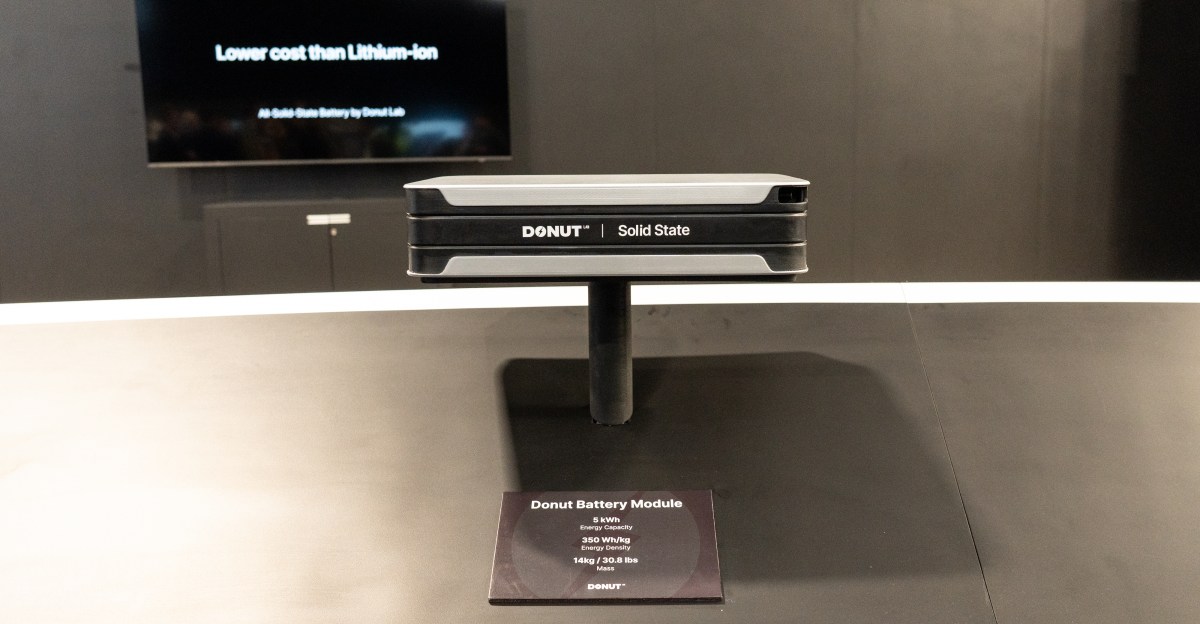
Donut Lab has been making waves in the battery technology industry with its announcement of a new solid-state battery earlier this year. There was initially some speculation about whether the battery was actually a supercapacitor in disguise, due to its fast charging and discharging capabilities. Supercapacitors are known for their quick energy transfer but lack the long-term energy storage capacity of traditional batteries.
To put these speculations to rest, Donut Lab commissioned an independent test by the VTT Technical Research Centre of Finland. The test aimed to evaluate the battery’s charge retention over an extended idle period, proving that it is indeed a solid-state battery and not a supercapacitor. The results showed that the battery retained 97.7 percent of its energy over a 10-day period, demonstrating high stability and debunking theories of it being a supercapacitor.
Unlike supercapacitors, which experience significant energy loss through self-discharge over time, Donut Lab’s battery showed normal battery-type charge retention. This test confirms that the battery is capable of long-term energy storage, making it a promising advancement in battery technology.
Donut Lab claims that its solid-state battery offers 400 watt-hours per kilogram, surpassing the energy density of most lithium-ion batteries on the market. Additionally, the battery can charge in under 10 minutes and last for 100,000 cycles, far exceeding the performance of current lithium-ion batteries.
Despite these impressive claims, there are still some unknowns about Donut Lab’s battery. Independent tests have yet to confirm the chemistry of the battery pack, and questions remain about how the startup is addressing issues such as dendrite growth, which can cause electrical shorts in solid-state batteries. Donut Lab has promised further independent test results as part of its “I Donut Believe” series, which may shed light on these unanswered questions.
Overall, Donut Lab’s solid-state battery has the potential to revolutionize the electric vehicle industry, offering improved energy density, faster charging times, and longer lifespan. As the company continues to push the boundaries of battery technology, it will be interesting to see how its innovations shape the future of energy storage.