
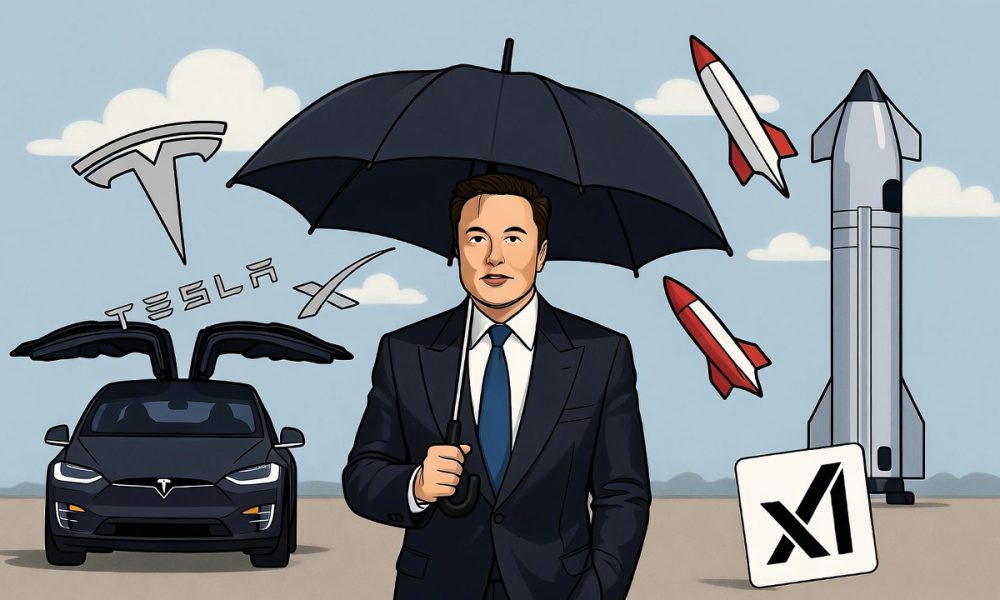
Elon Musk’s consolidation of his companies—SpaceX and xAI—under one umbrella has sparked excitement and speculation in the tech world. The merger, confirmed by Musk himself, aims to combine SpaceX’s expertise in launches with xAI’s advancements in artificial intelligence. This move aligns with Musk’s vision of space-based data centers that require substantial energy to operate efficiently.
The idea of merging Musk’s companies has been in the works for some time, with analysts now speculating if Tesla will be the next to join the fold. Dan Ives of Wedbush believes there is a “growing chance” that Tesla could merge with the new conglomerate in the next 12 to 18 months. The potential synergies between Tesla, SpaceX, and xAI could create a powerful AI ecosystem that leverages each company’s strengths.
A triple merger would create what some are calling the “Musk Trinity,” combining Tesla’s physical AI capabilities with SpaceX’s orbital infrastructure and xAI’s advanced AI models. This unified entity, potentially named “X,” could lead the way in multiplanetary AI-native technology, impacting everything from autonomous vehicles to complex AI training models.
Financially, the merger makes sense as it addresses the specific needs of each company. xAI’s high cash burn rate could be offset by SpaceX’s valuation boost, while Tesla’s investment in xAI could streamline its own expenditures for supercomputers and autonomous vehicles. Musk’s stake in Tesla and SpaceX would also see an increase, giving him stronger voting power and alignment across his ventures.
The timeline for a public announcement of the merger is uncertain, with predictions ranging from the near future to 2027 or later. Speculation suggests that a Tesla-SpaceX merger could happen before June 30 of this year, but the sequencing of events—starting with the SpaceX-xAI merger as “step one”—is crucial for a successful integration.
Overall, the SpaceX-xAI merger signifies Musk’s larger vision for a unified “Muskonomy” that combines AI, space infrastructure, and robotics to tackle humanity’s greatest challenges. While execution risks remain, the transformative potential of a vertically integrated AI-space-robotics giant is undeniable. It all hinges on Musk’s ability to execute at scale and deliver on the promise of a brighter, multi-planetary future.