
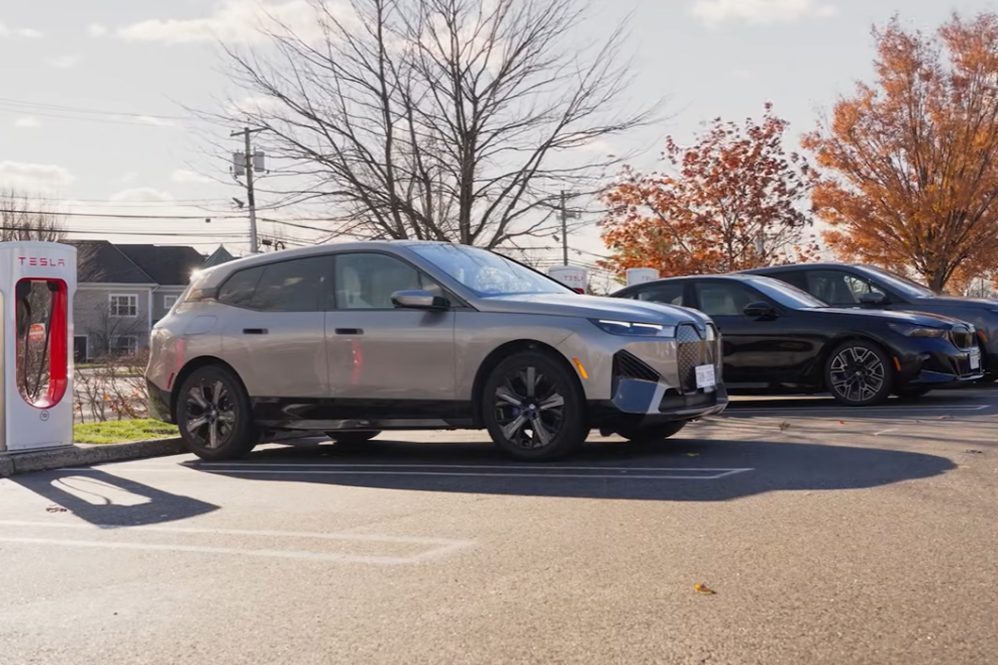
BMW Electric Vehicle (EV) drivers in the United States have reason to celebrate as they can now seamlessly access Tesla’s Supercharger network. This recent development signifies a significant expansion of the charging standard, which is quickly becoming the norm across North America. As of December 10, BMW EVs officially support Supercharger access, granting owners access to over 2,000 stations and more than 25,000 stalls.
The integration comes at a time when Tesla’s Supercharger network is rapidly growing. Tesla recently set a new usage record during the Thanksgiving travel period and unveiled its largest Supercharger site to date, boasting a massive 164 stalls in California. With over 75,000 Supercharger stalls worldwide, Tesla’s network continues to expand at an impressive pace.
For BMW drivers, this integration means immediate and substantial benefits. Supported BMW EVs, including models like the i4, i5, i7, and iX, can now charge at Tesla’s North American Charging Standard stations using a CCS-to-NACS adapter. While official BMW adapters won’t be available until Q2 2026, approved third-party options like Lectron’s are currently accessible. Moreover, BMW EVs can utilize Tesla’s Magic Dock locations without the need for an adapter, facilitating charging for older models such as the i3.
All compatible Superchargers are now visible in BMW’s navigation system and the My BMW app, alongside other charging networks like Electrify America, EVgo, ChargePoint, and IONNA. With roaming partners included, BMW drivers now have access to approximately 180,000 public charging points across North America. Billing and authentication are managed through Shell Recharge, and Plug & Charge is supported at Supercharger sites, eliminating the need for additional apps or screens once set up.
Despite these advancements, there are some caveats to be aware of. The 2026 iX and i5 40 models will require a remote software update in Q2 2026 before they can utilize Superchargers due to hardware discrepancies. BMW plans to incorporate native NACS ports into new models starting with the 2026 i5 M60 and the upcoming iX3, aligning with the automaker’s 2023 commitment to adopt the charging standard.
BMW now joins a growing list of automakers adopting the NACS standard, with Volkswagen gaining access just last month. Stellantis remains the last major brand awaiting compatibility with the Supercharger network.
In conclusion, the integration of BMW EVs with Tesla’s Supercharger network marks a significant milestone in the advancement of electric vehicle infrastructure in North America. This collaboration not only expands charging options for BMW drivers but also signifies a step towards a more unified and accessible charging ecosystem for all electric vehicle owners. The Impact of Artificial Intelligence on the Education System
Artificial intelligence (AI) has been revolutionizing various industries, and the education sector is no exception. With the advancements in AI technology, there has been a significant impact on the way students learn and teachers teach. From personalized learning experiences to increased efficiency in administrative tasks, AI is reshaping the education system in numerous ways.
One of the key benefits of AI in education is personalized learning. AI algorithms can analyze students’ learning patterns and adapt the curriculum to suit their individual needs. This means that students can learn at their own pace, receive targeted feedback, and have a more engaging learning experience. By tailoring the education process to each student’s strengths and weaknesses, AI can help improve academic performance and retention rates.
Another important aspect of AI in education is its ability to automate administrative tasks. From grading assignments to scheduling classes, AI can streamline time-consuming tasks for teachers, allowing them to focus more on teaching and mentoring students. This not only saves time but also reduces the risk of human error, leading to more accurate and efficient processes.
Furthermore, AI can also assist in the development of educational content. By analyzing vast amounts of data and trends, AI can help educators create more engaging and relevant learning materials. This can include interactive simulations, virtual reality experiences, and personalized learning modules that cater to different learning styles.
In addition, AI can also help identify students who may be struggling academically or emotionally. By analyzing data such as attendance records, grades, and social interactions, AI algorithms can flag students who may need extra support. This early intervention can help prevent students from falling behind and ensure they receive the help they need to succeed.
However, while AI offers numerous benefits in education, there are also challenges that need to be addressed. One of the main concerns is the potential bias in AI algorithms. If not properly trained and monitored, AI systems can perpetuate existing inequalities in education, such as racial or socioeconomic disparities. It is crucial for educators and policymakers to ensure that AI tools are ethically designed and used to promote equity and inclusivity in education.
Overall, the impact of AI on the education system is undeniable. From personalized learning experiences to increased efficiency in administrative tasks, AI is transforming the way students learn and teachers teach. By harnessing the power of AI technology, educators can create a more engaging, efficient, and equitable learning environment for all students.