
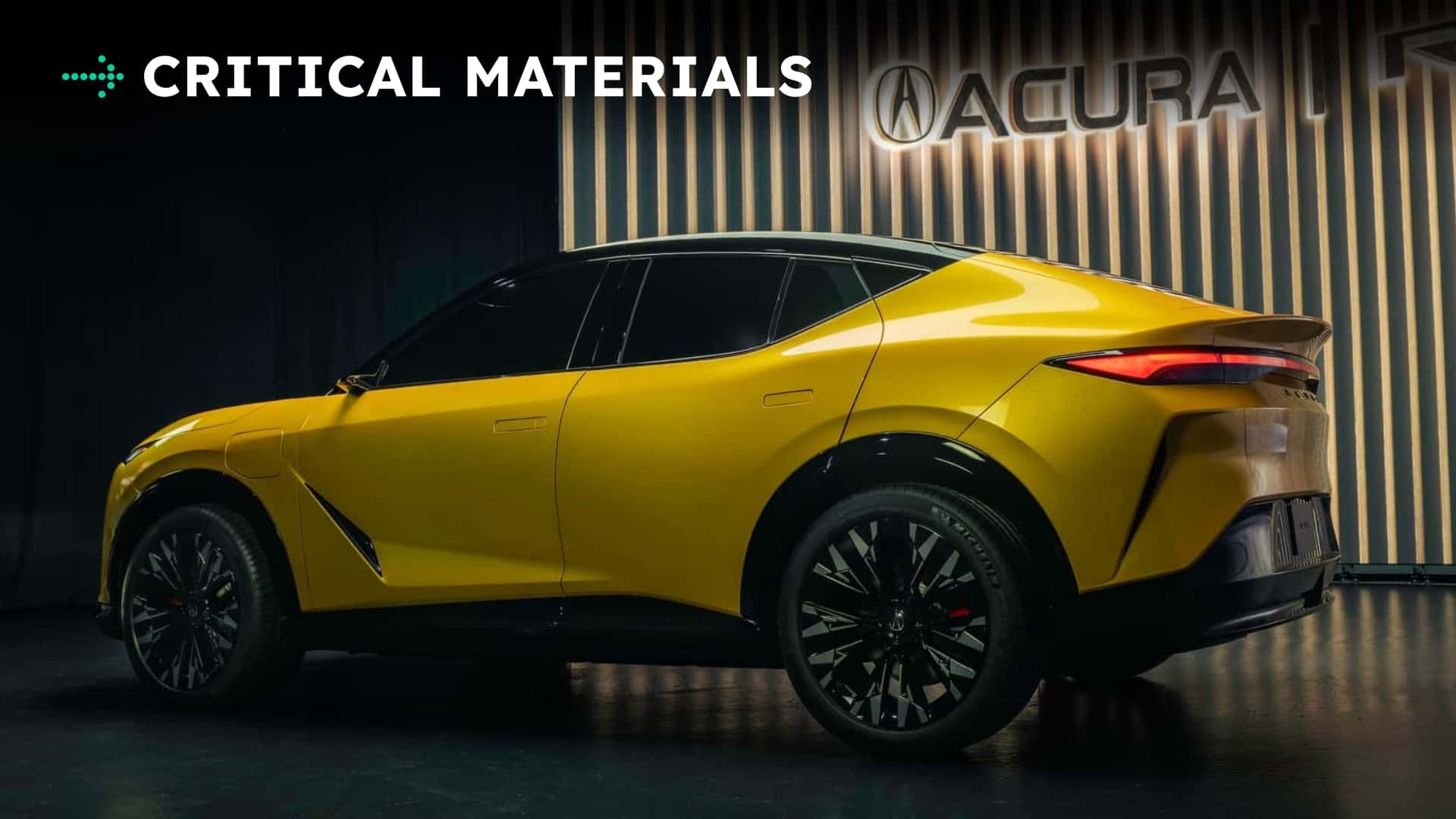
As the editor of InsideEVs, I don’t follow the gas-car market as closely as I once did. My colleagues at Motor1 will tell me all the time about new internal-combustion vehicles they’re testing, and my reaction is often: “That’s great! What is that?” But even I was surprised to learn that Acura would be temporarily discontinuing its top-selling RDX crossover.
Now, dealers are mad that they’re losing such an important car at a time when demand for its upcoming RSX electric model may not be as strong as it would’ve been with $7,500 tax credits in place. And they may have a point this time.
That kicks off this edition of Critical Materials, our morning roundup of industry and technology news. Also on deck today: Porsche’s China woes continue, and this whole “America needs to own Greenland” thing is bad for auto stocks. Let’s dig in.
Acura’s Dealers Are Mad About An EV Shift. They May Have A Point
I certainly don’t have strong feelings for the RDX. I can’t even recall the last time I drove one. But it is (or was) the kind of competitive, mass-market crossover that pays the bills for other things, as every automaker needs amid this expensive, rocky shift to electrification, advanced software, and autonomy.
But the RDX is going on a two-year hiatus before becoming a hybrid model. In the meantime, Acura is launching a smaller gas crossover, the ADX, and the electric RSX—one of the first cars on Honda’s new in-house EV platform, replacing the General Motors-made ZDX that was discontinued last year.
(A lot of three-letter names, I know. I don’t come up with this stuff.)
The point is, the RSX’s tech makes it a very big deal, especially for Honda and Acura, which are late to the game on electrification. Yet as Automotive News reports, dealers are unhappy because they’re without a mass-appealing crossover at a very uncertain time for EVs without the $7,500 tax credit:
“To cancel [RDX] production on such short notice just leaves us hanging,” said Brian Benstock, vice president at Paragon Acura in New York City.
Benstock attributed the predicament to Acura’s “stubborn” pursuit of EVs until recently. Dealers repeatedly had urged a hybrid focus and a diversified powertrain approach, he said.
Benstock estimates the MDX and ADX will recapture just 20 percent of RDX volume, given the distinct segments. “There’s a certain demand for the RDX, and when you take it away,” those customers are going to look at alternatives in that segment, he said.
“Acura chose a different strategy—one that was politically correct but wrong for the market,” Benstock said. “Now dealers are paying the price.”
Now, we know that very few traditional car dealers are excited about EVs. They were among the loudest voices pushing back against what they called an “EV mandate” in the Biden years. But they have kind of a point here: at a time of regulatory whiplash and changing consumer demand, how does a car company get the timing “right”?
In the future, most automakers in the U.S. will likely have a mix of gas, hybrid, and electric options; with the Trump administration rolling back strict fuel economy rules, car companies aren’t under the gun to deliver an all-electric future anymore. But that hardly means EV demand is going away. It is expected to pick up as battery costs fall in the latter part of this decade, and besides, a post-Trump White House or Congress could put an EV push back in play.
Still, the car companies don’t have infinite capital to play with. The automotive industry is facing a tumultuous period as companies navigate the rapidly changing landscape of consumer preferences and global economic conditions. With the push towards electrification and sustainability, automakers are scrambling to develop new powertrains, including electric and hybrid options, to meet future demands. However, investing in multiple powertrains simultaneously can be a risky strategy, as predicting consumer preferences accurately is no easy feat.
Dealers like Benstock caution against banking on future technologies that are still a few years away. Customers want options that are available now, and they are unlikely to wait for new models to hit the market. This sense of immediacy is especially evident in markets like China, where consumers have a wide array of choices when it comes to electric vehicles. Porsche, once a dominant player in the Chinese luxury car market, is now struggling to compete with local brands that offer compelling alternatives at a lower price point.
As automakers grapple with the challenges of shifting consumer preferences and intensifying competition, they are also facing geopolitical uncertainties that are impacting their stock prices. President Trump’s aggressive stance on tariffs and trade wars with European nations is causing further instability in the automotive sector. Companies like Volkswagen, BMW, and Mercedes-Benz are seeing their stock values plummet, while even luxury brands like Ferrari are not immune to the economic fallout.
The next few years will be critical for automakers as they try to navigate these turbulent waters. Balancing innovation with market realities, meeting consumer demands with sustainable practices, and adapting to geopolitical shifts will require agility and foresight. The automotive industry is in for a wild ride, and only those companies that can adapt quickly and make strategic decisions will emerge victorious in this ever-evolving landscape.
With the automotive industry rapidly evolving towards electrification, automakers are facing a critical challenge in determining the best mix of powertrains for their vehicles. The recent announcement of tariffs by President Trump has only added to the complexity of this decision-making process.
Germany’s Porsche and Milan-listed shares of Stellanti have already felt the impact of these new tariffs, with both companies seeing a decline in their stock prices. The threat of 10% tariffs on European countries by February 1 has sent shockwaves through the auto industry, particularly affecting companies with interconnected supply chains.
Analysts are warning that the auto industry, which is already grappling with Trump’s tariffs and regulatory changes in the U.S., will face even greater challenges in the coming years. The need for automakers to adapt and innovate has never been more pressing.
As we look towards 2026, automakers are under pressure to get their powertrains right. The shift towards electrification is reshaping the industry, with hybrid, gas, electric, and extended-range electric vehicles all vying for attention. Finding the optimal balance between these different powertrain options is crucial for automakers to remain competitive in the evolving market.
With uncertainty looming over the future of trade relations and regulatory environments, automakers must navigate a complex landscape to ensure their success in the years to come. The race to find the perfect powertrain mix is on, and only those who can adapt quickly and effectively will emerge victorious in the rapidly changing automotive industry.
Stay tuned as we continue to track the latest developments in the auto industry and explore how automakers are rising to the challenge of getting powertrains right in 2026 and beyond. The Importance of Mental Health in Today’s Society
In today’s fast-paced and high-pressure world, mental health has become an increasingly important topic of discussion. With the rise of stress, anxiety, and depression among individuals of all ages, it is crucial that we prioritize our mental well-being as much as our physical health.
Mental health refers to our emotional, psychological, and social well-being. It affects how we think, feel, and act, and plays a significant role in how we handle stress, relate to others, and make choices in our daily lives. When our mental health is compromised, it can have a profound impact on our overall quality of life.
One of the main reasons why mental health is so important is because it affects every aspect of our lives. For example, poor mental health can lead to decreased productivity at work, strained relationships with family and friends, and even physical health issues such as heart disease and obesity. By taking care of our mental health, we can improve our overall well-being and lead happier, more fulfilling lives.
Another reason why mental health is important is because it is often stigmatized in society. Many individuals feel ashamed or embarrassed to seek help for their mental health issues, which can prevent them from getting the support they need. By normalizing conversations about mental health and encouraging individuals to seek help when needed, we can break down these barriers and create a more supportive and understanding society.
Furthermore, prioritizing mental health can have a positive ripple effect on society as a whole. When individuals are mentally healthy, they are more likely to contribute to their communities, engage in meaningful relationships, and support others in need. By investing in mental health resources and support systems, we can create a more compassionate and empathetic society where individuals feel valued and supported.
In conclusion, mental health is a critical component of our overall well-being and should be a top priority in today’s society. By taking steps to improve our mental health, seek help when needed, and support others in their mental health journey, we can create a more resilient and thriving community for all. Let’s continue to prioritize mental health and work towards a healthier and happier society for everyone.