
In the rare event that your electric vehicle battery reaches 0% state of charge while road-tripping, rest assured that your car won’t suddenly come to a grinding halt in the middle of the road. Like gas cars, which all have a built-in fuel buffer even when the fuel gauge reads empty, EVs also have a similar reserve in the “tank” when the displayed state of charge hits 0%.
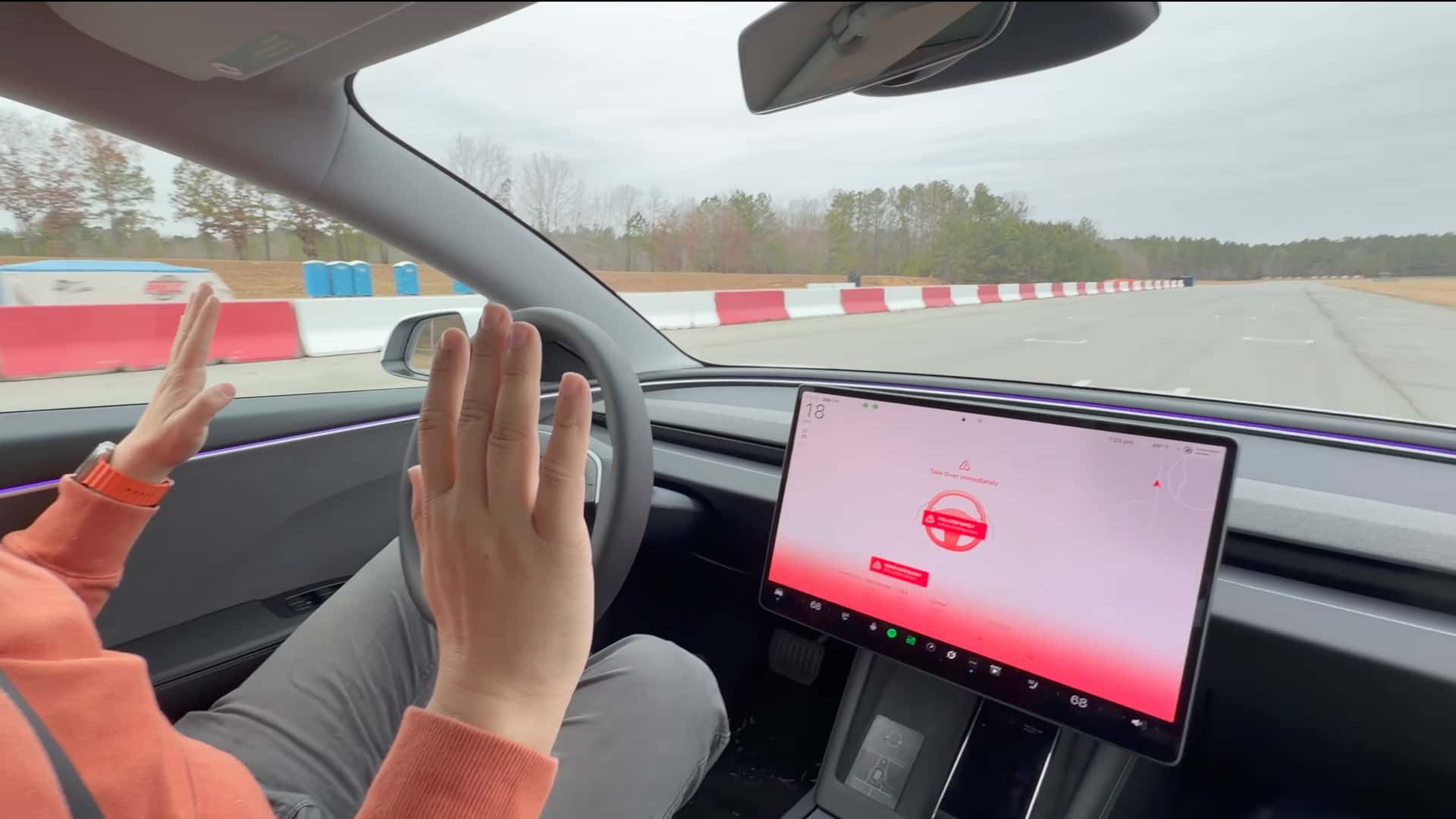
As Kyle Conner of the Out Of Spec YouTube channel recently demonstrated in his 2026 Tesla Model 3 Premium, the reserve energy in some modern EVs is pretty impressive. He took several steps before running the Model 3 until it died. He first preconditioned the battery to ensure it was nice and toasty, ready for a charge when it would die. Once that was done, he drove the EV on a closed circuit for safety, as running out of charge in the middle of a public road can be dangerous.
The test started at 5% state of charge, and the trip computer was reset when the indicated battery percentage reached 0% to find out exactly how far the EV would go below that threshold. And finally, the Model 3 was driven with Tesla’s Full Self-Driving (FSD) advanced driver assistance system activated, to see how it handles low-battery conditions such as this.
When the Model 3’s screen showed a 0% state of charge, it still displayed 2 miles of range remaining. But here’s the unexpected part: Once the displayed remaining range was 0 miles, the Model 3 continued driving for another 31 miles. After hitting 0%, the Model 3 consumed nearly 6 kilowatt-hours of electricity, proving that Tesla leaves a big buffer for emergencies. The Premium trim is already one of the longest-range electric sedans money can buy, with 363 miles of EPA range.
It covered that distance with an impressive efficiency of 192.5 watt-hours per mile, which translates to approximately 5 miles per kWh. FSD then asked the driver to take over and gradually stopped the car, displaying warnings on the screen that the vehicle was about to shut down.
Not all EVs will have a similarly large buffer, but all automakers ensure there’s some energy remaining when the cluster reads 0% state of charge, giving owners a few extra miles of range to reach the next charging station. Still, you should try not to rely on the reserve battery energy—in part because it’s best practice for battery health not to discharge a car all the way to empty. Planning ahead and knowing your charging stops is always advisable. The world is constantly changing, and with it, so is our understanding of the universe. As technology advances and scientists delve deeper into the mysteries of the cosmos, new discoveries are being made that challenge our existing beliefs and theories.
One such discovery that has captured the attention of both the scientific community and the general public is the recent detection of gravitational waves. These ripples in the fabric of spacetime were first predicted by Albert Einstein in his theory of general relativity over a century ago, but it wasn’t until 2015 that they were finally observed by the Laser Interferometer Gravitational-Wave Observatory (LIGO).
Gravitational waves are produced by cataclysmic events in the universe, such as the collision of black holes or the merger of neutron stars. When these massive objects interact, they create ripples in spacetime that travel outward at the speed of light, carrying information about the event that produced them.
The detection of gravitational waves has opened up a whole new window into the universe, allowing scientists to study phenomena that were previously inaccessible. By observing these waves, researchers can learn more about the nature of black holes, neutron stars, and other extreme objects in the cosmos.
In addition to shedding light on the behavior of these exotic objects, gravitational waves also provide a new way to test the predictions of general relativity. By comparing the observed properties of gravitational waves with the theoretical predictions of Einstein’s theory, scientists can confirm or refine our understanding of the fundamental forces that govern the universe.
But perhaps the most exciting aspect of gravitational wave astronomy is the potential for new discoveries. Just as the invention of the telescope revolutionized our understanding of the cosmos, the detection of gravitational waves promises to reveal new insights into the nature of the universe and our place within it.
Already, scientists have used gravitational wave observations to study the properties of black holes, measure the expansion rate of the universe, and even test the limits of our current theories of gravity. As technology continues to improve and more gravitational wave detectors come online, we can expect even more groundbreaking discoveries in the years to come.
In conclusion, the detection of gravitational waves represents a major milestone in our quest to understand the universe. By studying these ripples in spacetime, scientists are opening up a new era of discovery and exploration that promises to revolutionize our understanding of the cosmos. As we continue to push the boundaries of our knowledge, who knows what other secrets the universe may have in store for us?