
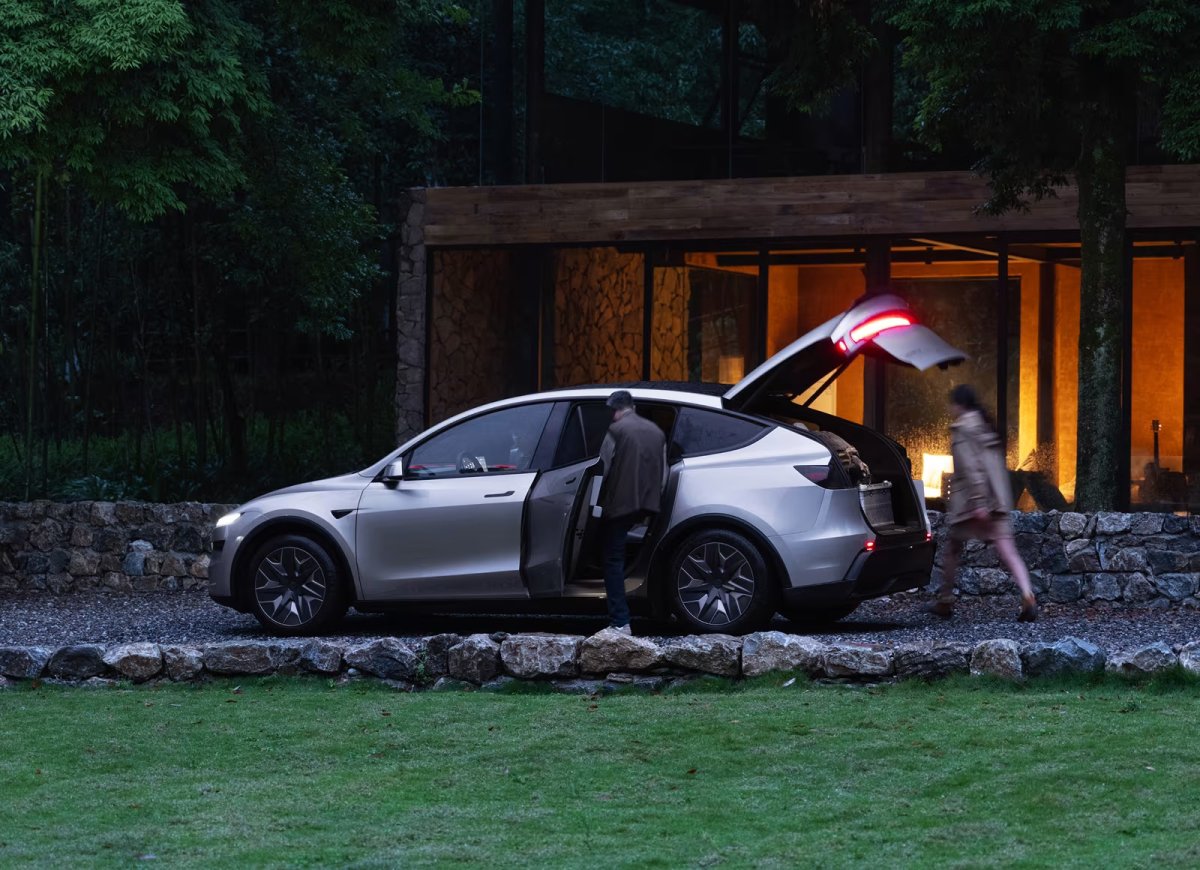
Tesla Introduces Vehicle-to-Load (V2L) Capability to Model Y L in Latest Software Update
Tesla has recently released a groundbreaking software update in China for the Model Y L, bringing vehicle-to-load (V2L) capability to this popular electric vehicle. This update allows owners to power external devices directly from their Model Y L, expanding its functionality and versatility.
Previously, only the Model Y Performance variant and the Cybertruck had V2L capabilities. The Cybertruck, in particular, is known for its ability to power an entire home with its energy output. Now, the Model Y L joins the ranks of Tesla vehicles that can support V2L functionality.
With the latest software update, users can now connect household devices such as coffee makers, laptops, and small kitchen appliances to their Model Y L. This feature proves to be useful for various scenarios, including camping trips, outdoor activities, and emergency backup power situations. Additionally, owners can even use their Model Y L to charge another Tesla, although the power output is limited to 20 amps at 120V or 2.4kW.
While the Model Y Performance was the first Tesla model to support V2L after the Cybertruck, the addition of this feature to the Model Y L in software update 2025.32 came as a pleasant surprise to many Tesla enthusiasts. It is expected that V2L capabilities will be included in future Tesla models as they are introduced in different regions.
Although Tesla has not extended V2L capabilities to existing models, third-party efforts have shown that it is possible to extract energy from these vehicles. However, Tesla may have concerns about battery degradation, which could be why they have not made this feature widely available.
The Model Y Performance features newer Panasonic batteries that are likely more durable and capable of sustaining multiple charge cycles over their lifetimes. This gives Tesla the confidence to enable V2L capabilities on this model while still meeting warranty standards.
As Tesla continues to innovate and release new models, it is uncertain whether V2L capabilities will be included in upcoming consumer-focused vehicles. However, if the feature relies on the advanced Panasonic batteries found in the Model Y Performance, there is a possibility that future versions of existing models could incorporate V2L functionality.
In conclusion, Tesla’s addition of V2L capabilities to the Model Y L showcases the company’s commitment to innovation and sustainability in the electric vehicle market. Owners can now enjoy enhanced functionality and convenience with their Model Y L, making it a versatile and practical choice for eco-conscious consumers.