
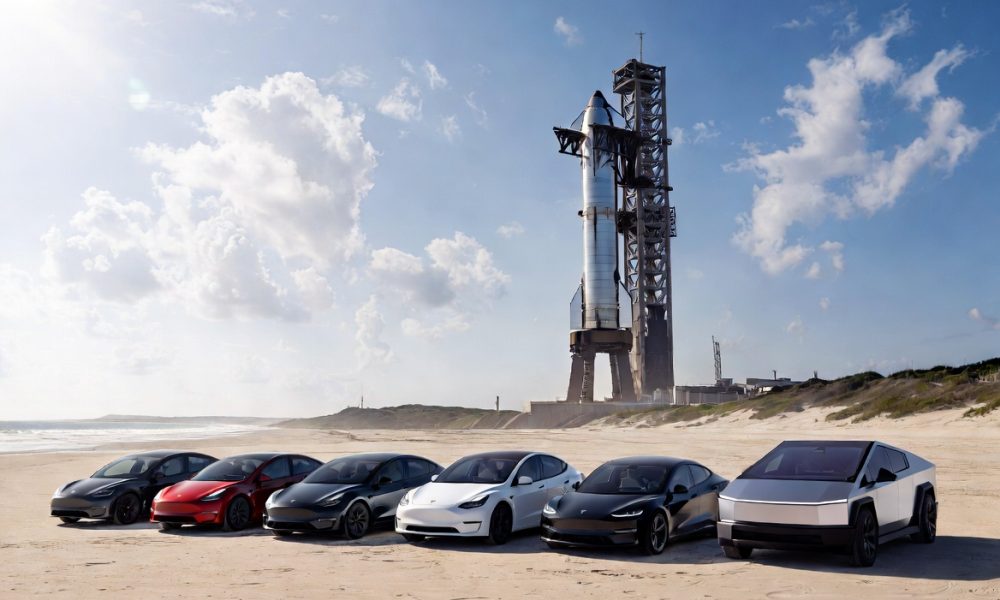
SpaceX: The Next AI Powerhouse
When Elon Musk founded Tesla in 2003, it was a plucky electric car startup betting everything on lithium-ion batteries and a niche luxury Roadster. Fast forward two decades, and Tesla has evolved into more than just a car company. Its valuation now hinges on Full Self-Driving software, the Optimus humanoid robot, the Robotaxi program, and the Dojo supercomputer cluster purpose-built for AI training. Musk has repeatedly referred to Tesla as an AI and robotics company that happens to sell vehicles, with cars being the first scalable platform for real-world AI.
Now, SpaceX is following a similar trajectory, albeit at a faster pace and in a direction that few anticipated. Originally founded in 2002 to revolutionize spaceflight and enable multiplanetary exploration, SpaceX spent its first two decades focusing on perfecting reusable rockets, landing Falcon 9 boosters, and building the Starlink megaconstellation.
However, in early 2026, SpaceX made a significant shift towards becoming one of the world’s most ambitious AI companies following its acquisition of xAI in February. The all-stock transaction valued the combined entity at around $1.25 trillion, with Musk framing the merger as the creation of the most ambitious innovation engine on (and off) Earth.
The new SpaceX now owns Grok, a large language model family that powers the chatbot of the same name, along with xAI’s extensive training infrastructure. The company’s mission now includes moving AI compute off-planet to overcome the limitations of Earth-based data centers in terms of power, cooling, and land. Musk’s vision involves deploying orbital data centers comprised of solar-powered satellites acting as supercomputers in space.
SpaceX has already sought regulatory approval to launch up to one million satellites for this purpose. Starship, the company’s fully reusable heavy-lift vehicle, is crucial for delivering the necessary mass at the required cadence. Musk predicts that within a few years, space-based AI inference and training could become more cost-effective than terrestrial solutions.
SpaceX’s strategic focus on AI is further underscored by its recent move to acquire Cursor, an AI coding tool, for $60 billion. This acquisition positions SpaceX to dominate AI developer tools, much like Tesla dominates autonomous driving software.
The parallels between Tesla and SpaceX are evident. Both companies started in capital-intensive sectors—Tesla with EVs and SpaceX with launch vehicles—before transitioning to focus on AI at scale. Just as Tesla’s Dojo supercomputers train neural nets on real-world driving data, SpaceX now leverages telemetry from orbital assets and re-entries for AI training.
SpaceX’s shift towards becoming an AI powerhouse reflects deliberate convergence rather than unfocused expansion. The company’s forthcoming IPO is expected to position it as a bet on AI infrastructure rather than a space endeavor. Despite challenges such as regulatory scrutiny and engineering complexities, SpaceX’s vision for orbital data centers powered by AI is clear.
In conclusion, SpaceX is no longer just a rocket company but an AI powerhouse with a unique competitive advantage in orbital infrastructure. The age of space-based AI is dawning, and SpaceX is at the forefront of this technological revolution.