
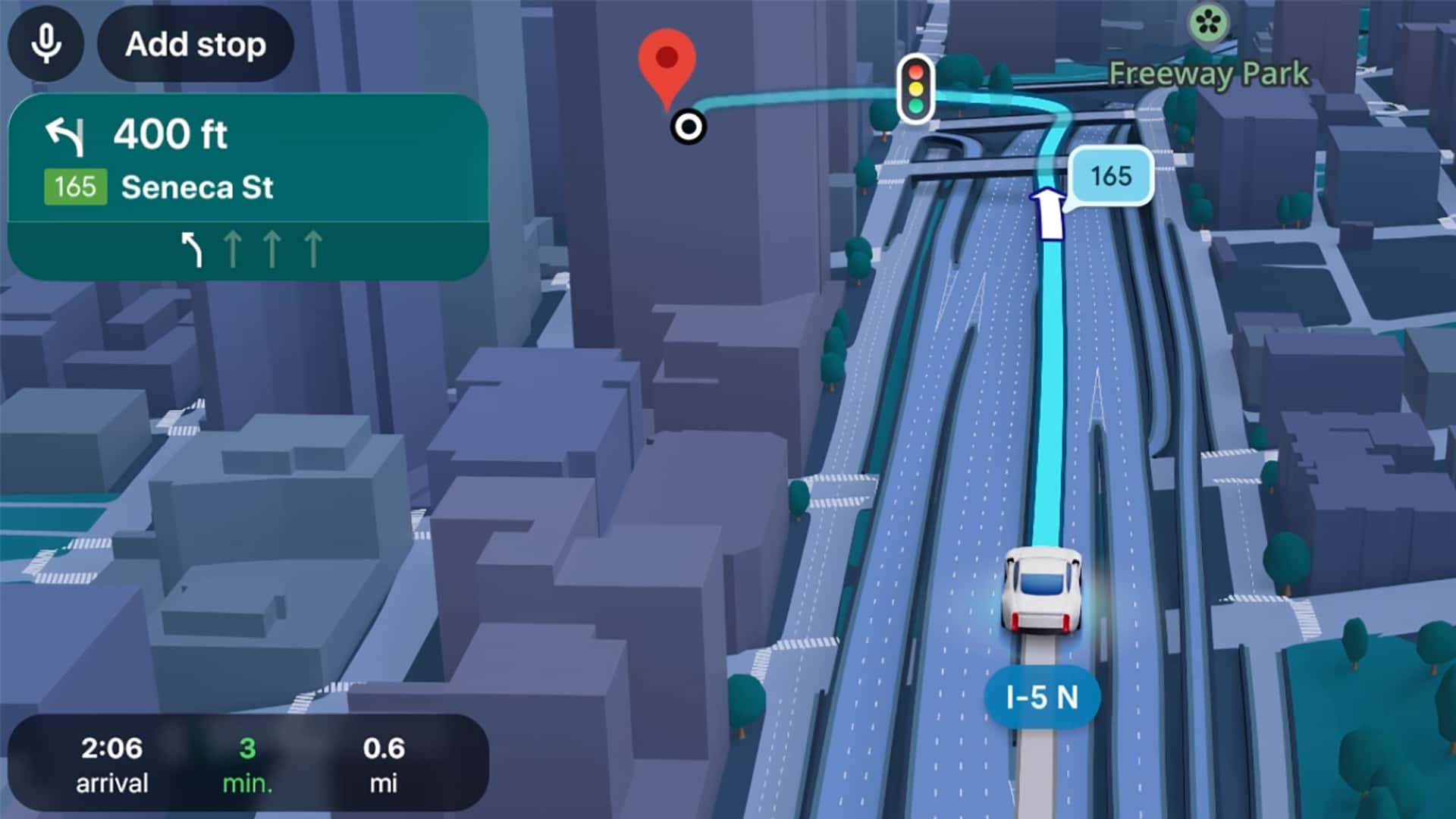
Google Maps is set to receive a major update that will revolutionize the way users navigate through the app. One of the key features of this update is the introduction of the new “Immersive Navigation” mode, which brings a detailed 3D map that includes buildings, crosswalks, stop lights, and more. This mode aims to provide drivers with a more realistic and informative view of their surroundings while on the road.
According to Google, this update marks the most significant change to the app’s driving experience in over a decade. The enhanced visuals are made possible by Google’s Gemini artificial intelligence models, which analyze real-world imagery to create accurate representations of objects along a route. This includes landmarks, medians, and other important elements that help drivers stay informed and focused while driving.
In addition to the visual upgrades, Google Maps will also introduce new features to enhance the overall user experience. Smart zooms and transparent buildings will show drivers more of their route, helping them prepare for their next move. The voice guidance has also been improved to sound more natural, providing directions in a friendly and clear manner.
Furthermore, the app will now alert drivers in real-time about disruptions along their route and offer trade-offs for alternative routes. Users can visualize their destination before heading out, with Street View imagery and parking recommendations. When nearing the destination, Maps will highlight the building’s entrance and which side of the street to be on for easier navigation.
The new Immersive Navigation mode is currently rolling out in the United States and will be available to eligible iOS and Android devices, as well as Apple CarPlay, Android Auto, and cars with Google built-in in the coming months.
But that’s not all – Google is also integrating its Gemini AI assistant into Maps, allowing users to ask questions and start conversations with the app. This new feature, called Ask Maps, enables users to inquire about various topics, such as nearby charging stations or recreational facilities. The results are personalized based on the user’s previous searches and saved locations, making trip planning and exploration easier and more convenient.
The conversational feature is currently being rolled out in the U.S., offering users a new way to interact with Google Maps and access personalized information to enhance their navigation experience. With these updates, Google Maps continues to evolve as a comprehensive and user-friendly navigation app for drivers around the world. the perspective of a journalist covering a groundbreaking scientific discovery:
In a historic moment for the field of astronomy, researchers have announced the discovery of a new planet outside of our solar system that has the potential to support life. The planet, named Kepler-452b, was identified by the Kepler Space Telescope and is located in the habitable zone of its star, meaning it could have liquid water on its surface.
This discovery marks a significant milestone in the search for extraterrestrial life, as Kepler-452b is the most Earth-like planet ever discovered. Its size and distance from its star make it a prime candidate for hosting life as we know it. Scientists believe that the planet may have a rocky surface and a similar atmosphere to Earth, making it a potential haven for living organisms.
Dr. Sarah Johnson, lead researcher on the project, expressed her excitement about the discovery, stating, “Kepler-452b represents a major step forward in our understanding of exoplanets and their potential for supporting life. This planet has all the right conditions for life to thrive, and we are eager to learn more about its composition and atmosphere.”
The discovery of Kepler-452b has sparked renewed interest in the search for other Earth-like planets in the galaxy. With the advancements in technology and data analysis, astronomers are now able to detect smaller and more distant planets with greater accuracy. This has opened up new possibilities for finding planets that may be capable of sustaining life.
In addition to its potential for hosting life, Kepler-452b also offers researchers a unique opportunity to study the formation and evolution of planets outside of our solar system. By observing the planet’s orbit and characteristics, scientists hope to gain insight into the processes that shape planetary systems in other parts of the galaxy.
As the scientific community continues to unravel the mysteries of the universe, the discovery of Kepler-452b stands as a testament to human curiosity and ingenuity. With each new breakthrough, we come one step closer to answering the age-old question: are we alone in the universe?